REVIEW · TOKYO
Full-Day Accessible Tour of Tokyo for Wheelchair Users
Book on Viator →Operated by Trip Designer Inc. · Bookable on Viator
A day in Tokyo, planned for wheelchairs. This private tour links the key sights with a wheelchair-friendly route and includes train tickets, so you spend less time figuring things out. I especially like the slow, comfortable pacing with a guide who keeps the whole group together, plus the hotel pickup/drop within Tokyo’s 23 wards; the main trade-off is you’ll still want to plan around no food included and bring water/snacks if that matters for you.
You start in Asakusa and move across Tokyo by train like locals, with transfers handled and time built in for questions. The itinerary hits big-name landmarks—Senso-ji, Meiji Jingu, and the iconic Shibuya moment—then balances them with streets that feel more like real daily life, like Harajuku-style shopping lanes and Omotesando’s leafy boulevard. It’s set up for your pace, which matters when crowds, curb cuts, and station layouts can eat up time fast.
If you’re visiting Tokyo with mobility needs (or you’re the caregiver planning for them), this kind of planning is the value. You’re not rushing between stops; you’re getting a guided route that aims to avoid the worst friction points—then the guide helps you do it in a way that’s easier on the body and less stressful on the mind.
In This Review
- Key highlights at a glance
- Price and what you truly get for $191.08
- How the day flows: 7 hours of Tokyo without the scramble
- Start in Asakusa: Kengo Kuma’s Asakusa Culture Tourist Information Center
- Walking into Senso-ji via Nakamise and Kaminarimon
- Sumida Park: river views, Tokyo Skytree in the distance
- Shibuya Crossing: the world-famous moment, timed by your guide
- Cat Street in Shibuya: street fashion vibes without the formality
- Meiji Jingu: calm in the middle of Harajuku’s station life
- Omotesando: tree-lined boulevard, fashionable Aoyama energy
- Guides, pace, and why this tour feels easier than DIY
- Mobility and accessibility: what to plan for (without guessing)
- Included transport: train tickets that save time and reduce stress
- Food is the only major missing piece
- Who this tour is best for
- Should you book this wheelchair-friendly Tokyo highlights tour?
- FAQ
- What time does the tour start?
- How long is the full-day tour?
- Is hotel pickup and drop-off included?
- Are train tickets included?
- What’s not included in the price?
- Can I cancel for a full refund?
Key highlights at a glance
- Private wheelchair-focused route with barrier-aware planning across multiple neighborhoods
- Train tickets included so you’re not scrambling to buy fares mid-day
- Hotel pickup and drop-off within Tokyo’s 23 wards, to reduce transfer stress
- Go at your pace with time for questions and short adjustments as needed
- Iconic sights plus street-level Tokyo, from Senso-ji to Shibuya Crossing and Cat Street
- Guides who support mobility navigation, including helping with how to move through stations with less fuss
Price and what you truly get for $191.08
At $191.08 per person, this isn’t a budget add-on. It’s closer to paying for time, planning, and a guide who can actually run a route that works for wheelchairs. Here’s what you’re paying for, in practical terms:
- Private tour (just your group), not a packed group with a fast-moving script.
- Hotel pickup and drop-off within the 23 wards. That alone can save you from multiple station transfers and the extra walking that often comes with them.
- Train tickets included. In Tokyo, that matters. The train system is efficient, but it can be confusing—especially when you’re also thinking about ramps, platforms, and getting to the right exit.
- A professional guide who can slow down for questions and adjust when people need a breather.
What you’ll want to mentally budget separately: food and drinks. The day is built around sightseeing, not meals. If you know you’ll need snacks, consider bringing them. Water stops can be your friend on a long day, especially in dense areas like Asakusa and Shibuya.
You can also read our reviews of more tours and experiences in Tokyo

How the day flows: 7 hours of Tokyo without the scramble
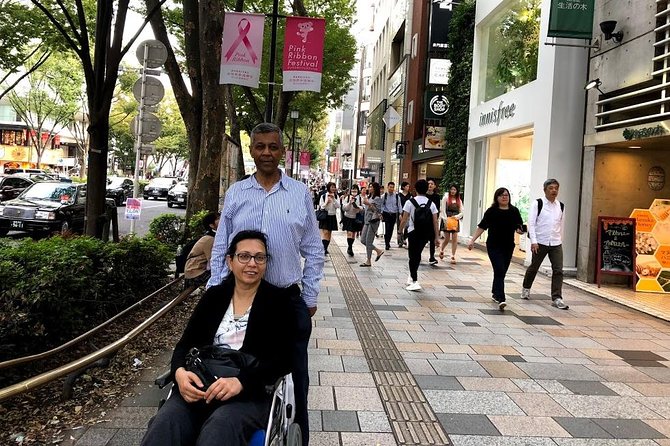
The tour runs about 7 hours, starting at 9:30 am. The meeting point is the Asakusa Culture Tourist Information Center (right by Kaminarimon), and the tour ends back at that same starting point.
That “out and back” structure is underrated for mobility. You’re not guessing where the tour will finish or how you’ll get home. You’ll also have a cleaner mental map of the day: start in Asakusa, work your way through central Tokyo, and return.
One more detail that affects planning: the tour notes moderate physical fitness. “Moderate” doesn’t mean you’ll be running around. It usually means there may be some walking along routes even with wheelchair access—plus you’ll want to be ready for crowds and a full morning-to-afternoon timeline.
And it’s set up as a private booking with a minimum of 2 people (including caregivers) per booking. So if you’re traveling solo with a guide, you may need a companion or caregiver so the tour can run.
Start in Asakusa: Kengo Kuma’s Asakusa Culture Tourist Information Center
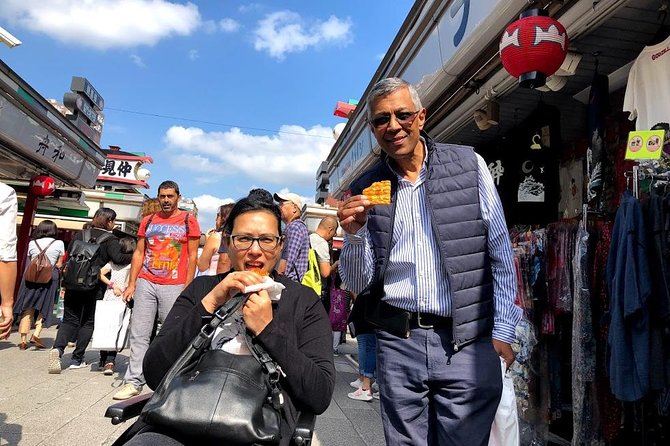
Your day kicks off at the Asakusa Culture Tourist Information Center, a newer landmark designed by Kengo Kuma. It’s an 8-story building, and the best way to think of this stop is as your launchpad.
I like this start because it sets context before you walk into the older, more crowded areas. You get orientation first, then the day feels less like random wandering and more like an ordered route.
What to expect:
- A useful place to reset and plan your first steps.
- A building that signals how modern Tokyo supports visitor movement—especially helpful for anyone who wants clear guidance early.
Time on this stop is short—about 15 minutes—but it matters. In dense cities, the first 15 minutes can either reduce stress or create it.
Walking into Senso-ji via Nakamise and Kaminarimon
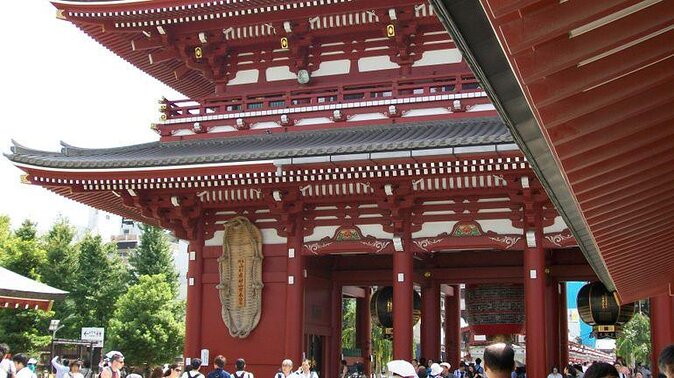
Next comes Nakamise Shopping Street, beginning at Kaminarimon (Thunder Gate), the outer gateway to Senso-ji. This is the classic Asakusa arrival sequence, and even if you’ve seen photos, it hits differently in person because it’s a layered experience: gate, shopping lane, temple approach, and the river-adjacent feeling nearby.
This part is free-flow sightseeing. Expect:
- A short window to experience the street atmosphere.
- The temple approach built right into the route.
Then you move to Senso-ji Temple itself. It’s known as one of Tokyo’s most popular temples, and it’s famous for its color and energy. You’ll get a guided look at what you’re seeing and why it matters, without feeling like you’re being marched through.
A practical note: Asakusa can get crowded fast. The advantage of having a guide who understands how to keep the group moving is that you’ll spend less time trapped in bottlenecks and more time actually looking.
Sumida Park: river views, Tokyo Skytree in the distance
After Asakusa’s temple energy, you get a breather at Sumida Park, near Asakusa Station along the Sumida River. This stop is short—around 15 minutes—but it’s well placed: it breaks up the heavy sightseeing loop with open views.
You can catch scenic sightlines toward Tokyo Skytree, and if you’re visiting around cherry blossom season, this park becomes even more photogenic.
Why this works on a wheelchair-focused tour:
- Outdoor views reduce the “always indoors, always crowded” feeling.
- It’s a natural place to pause, regroup, and ask questions without the strict pace of a temple approach.





Shibuya Crossing: the world-famous moment, timed by your guide
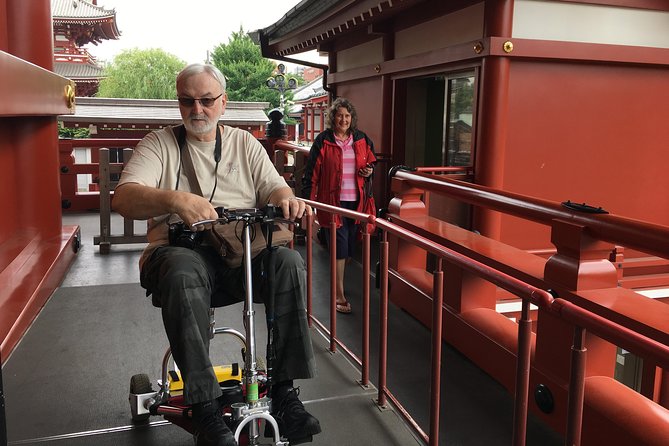
Then it’s off to Shibuya Crossing, near Shibuya Station. This is the photo magnet, the one that looks like organized chaos.
The tour schedule flags the scale: up to 500,000 people per day, and at peak times 3,000 people cross on one green light. That’s the kind of statistic that makes you realize why planning matters here.
What you can expect:
- A short, guided viewing that helps you find a comfortable spot.
- Time to experience the moment without sprinting between curb lines.
A friendly reality check: Shibuya is busy. Even with accessibility planning, you may still feel the crowd pressure. Your guide’s role is to help you choose where to pause and how to manage the flow so you’re not constantly fighting the stream of people.
Cat Street in Shibuya: street fashion vibes without the formality
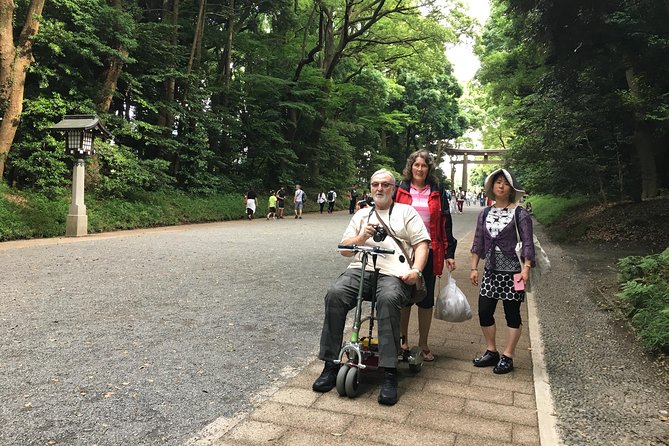
From the crossing, you head to Shibuya Cat Street, a fashion-forward pedestrian-style lane between Harajuku and Shibuya. It’s known for its youthful energy and fashion stores, and the route gives you about 25 minutes here—enough to browse without feeling rushed.
Why this stop is a good “real Tokyo” contrast:
- After a major landmark moment (Shibuya Crossing), Cat Street feels more like daily street life.
- It’s a change of pace: less “sit and look,” more “walk and absorb the vibe.”
The tour describes it as a roughly half-mile-long shopping stretch lined with stores, so you’ll want to use your guide to choose a comfortable viewing and browsing pace—especially if your group includes wheelchair users and walkers who need different rhythms.
Meiji Jingu: calm in the middle of Harajuku’s station life
Next up: Meiji Jingu Shrine. It’s dedicated to the deified spirits of Emperor Meiji and Empress Shoken, and it sits right by the busy JR Yamanote Line through Harajuku.
This is a powerful contrast stop. Shibuya and Harajuku can feel loud and fast; Meiji Jingu gives you a quiet, grounded transition. The schedule gives it the longest time block after Asakusa: about 50 minutes.
What I’d focus on here:
- Let the space slow you down. Shrines often feel different once you’re not rushing.
- Use your guide to understand what you’re seeing—especially the difference in how people interact with shrines versus temples (something guides often explain clearly).
This stop is free to enter, and it’s one of those places where the best experience often comes from lingering, not just checking off points.
Omotesando: tree-lined boulevard, fashionable Aoyama energy
You finish this central loop at Omotesando, a sloping, tree-lined boulevard in the Aoyama area where Shibuya and Minato wards meet. The vibe here is upscale and stylish, with a more architectural feel than the street markets earlier in the day.
You get about 20 minutes here, which works as a “final aesthetic walk” before the tour returns to your meeting point.
Why Omotesando is a smart closer:
- It’s visually distinct from Asakusa and Shibuya.
- It gives you a calmer, straighter feel for photos and a wrap-up stroll.
Guides, pace, and why this tour feels easier than DIY
This is where the tour’s reputation really makes sense. Tokyo’s greatest difficulty for many visitors isn’t the attractions—it’s the logistics: figuring out train routes, navigating station exits, dealing with crowds, and keeping everyone together.
The tour is built to remove that burden. Your guide is there to help with:
- Where to go next
- How to move through train systems
- Keeping the day comfortable and not overstuffed
In particular, the feedback you’ll see around this tour style often emphasizes that guides handle meeting points smoothly and explain the day as you go—so you’re not relying on guesswork. Names like Michiko, Fumiko, Machiko, Kaori, Emiko, Yumi, and Keita come up as examples of guides who stayed organized, stayed attentive to mobility needs, and kept the route manageable even in packed areas like Asakusa.
You should expect real human attention, not a headset guide that gives the same speech to everyone. And because it’s private, you can ask practical questions—like where the safest stopping spots are, when to pause, and how to tailor the pace.
Mobility and accessibility: what to plan for (without guessing)
The tour is designed as barrier-aware for wheelchair users, and that’s a big deal. But there are a few realistic considerations you should take into account so there are no surprises:
- Some parts of Tokyo require careful station navigation. Even when elevators or ramps exist, timing and route choices matter.
- Crowds can still be an issue, especially at Shibuya Crossing and around shopping streets.
- The tour is paced for comfort, but you should still expect some walking along accessible routes as needed.
One helpful trick: if your group includes different mobility styles (wheelchair plus walker/rollator, for example), ask your guide early about how you’ll handle group spacing. The tour’s strength is that it can adjust on the fly—so it helps to communicate your preferences at the start.
Included transport: train tickets that save time and reduce stress
A big “value” feature here is that train tickets are included. In Tokyo, ticketing and route planning can feel like an extra job on top of sightseeing.
With tickets handled, you focus on:
- Getting on the correct train
- Managing station movement
- Watching for cues from your guide about exits and timing
This is especially useful for wheelchair users, because the wrong exit or a last-minute detour can create a pile-up of effort. When the guide plans the route, you lose less time to re-routing.
And because hotel pickup/drop-off is included within the 23 wards, you’re not left stitching together your own taxi-to-station plan.
Food is the only major missing piece
The tour includes guide, taxes, train tickets, and transfers—but not food and drinks. That’s not a flaw, it’s just a sign of how the itinerary is built: stops are designed around sights and street time, not set restaurants.
For a smooth day:
- Bring snacks or plan to buy them during street time gaps.
- Keep water handy.
- If you have dietary needs, having your own backup snack can reduce stress during crowded stretches.
Who this tour is best for
This tour is a great fit if:
- You or your group uses a wheelchair and want a planned route with fewer logistics headaches.
- You want big Tokyo highlights plus street-level neighborhoods, without sprinting.
- You’re traveling with a caregiver who needs the day to feel organized and predictable.
- Your group includes mixed mobility levels and you want the guide to help smooth out timing differences.
It may be less ideal if:
- You prefer to travel completely independently with zero structure.
- You want a deep meal experience or a day structured around long sit-down lunches (since food isn’t included).
Should you book this wheelchair-friendly Tokyo highlights tour?
I’d book it if you want Tokyo’s greatest hits—Senso-ji, Shibuya Crossing, Meiji Jingu—served in a format that respects mobility needs. The strongest reason is the mix of private attention, included train tickets, and hotel pickup/drop-off. That combination removes the biggest time-killers: confusing transfers and crowded navigation.
If your main worry is logistics, this tour is built to fix that. If your main concern is food, plan for it yourself and you’ll be fine. Given the strong overall satisfaction score and the focus on wheelchair-friendly pacing, this is one of those rare tours that makes Tokyo feel more doable and more enjoyable on the ground.
FAQ
What time does the tour start?
The tour starts at 9:30 am.
How long is the full-day tour?
It runs for about 7 hours.
Is hotel pickup and drop-off included?
Yes. Hotel pickup and drop-off are included within Tokyo’s 23 wards.
Are train tickets included?
Yes. The tour includes train tickets as part of the experience.
What’s not included in the price?
Food and drinks are not included. Private transportation like taxi or car is available for an extra fee.
Can I cancel for a full refund?
Yes. Free cancellation is available up to 24 hours in advance of the experience start time for a full refund.