REVIEW · TOKYO
Tokyo: Imperial Palace, Edo Castle and Historical Tour
Book on GetYourGuide →Operated by Traveling Tokyo · Bookable on GetYourGuide
A quiet walk with serious Tokyo swagger. This Imperial Palace East Gardens tour turns the area around the palace into a timeline you can follow, from Edo Castle foundations to samurai-era gates and moats. I like that you get both the postcard gardens and the harder-to-grasp power story of Tokugawa rule and the shift to imperial authority.
Two things I really love: you’ll see Ninomaru Garden with its ponds and seasonal flowers, and you’ll get clear guided stops at major ruins and entrances like the Sakurada-mon area. The one thing to consider is that you’re moving on foot for about 1.5–2 hours, so you’ll want comfortable shoes and a calm pace for photo stops and short explanations.
In This Review
- Key things to know before you go
- From Starbucks to history: your starting point and the pace
- Tokyo Imperial Palace: what you can learn from a photo stop
- Imperial Palace East Gardens and Ninomaru Garden ponds
- Edo Castle stone ruins, gates, and moats you can picture
- Sakurada-mon Gate: one stop, a lot of meaning
- Guides make it: Tony, Jim, and Bell-style clarity
- Price and value: $22 for entry plus guided interpretation
- How to make the most of it on the ground
- Who this tour fits best (and who might want something else)
- Should you book the Imperial Palace East Gardens + Edo Castle tour?
- FAQ
- How long is the Tokyo Imperial Palace, Edo Castle and Historical Tour?
- Where do we meet for the tour?
- Is the tour guided in English?
- Is admission to the Imperial Palace East Gardens included?
- What major areas do we visit during the tour?
- Do you see Edo Castle remnants on this tour?
- Is the tour wheelchair accessible?
- Can I cancel and get a full refund?
- Is there a pay-later option?
Key things to know before you go
- Edo Castle stone remains: you’ll walk where shoguns once controlled the city.
- Ninomaru Garden time: a dedicated 45-minute stretch for ponds, seasonal blooms, and quiet pacing.
- Sakurada-mon Gate stop: you’ll get commentary and sightseeing around one of the main entrances.
- English live guide: real explanations, plus room for questions.
- Entry included: admission to the East Gardens is part of the tour price.
- Wheelchair accessible: the route is designed to be workable for mobility needs.
From Starbucks to history: your starting point and the pace
The tour starts at a Starbucks just close to the Imperial Palace East Gardens (near the Kokyo Gaien Wadakura Fountain Park area). You meet in front of that Starbucks, and the exact meeting details are provided after booking. I’d treat it like a city walk where navigation matters: show up a few minutes early so you can start smoothly.
The whole thing runs about 90 minutes (about 1.5 to 2 hours). That’s long enough to connect the dots between eras without feeling like a full-day commitment. You’ll have short photo moments and guided walking time at each stop, so you’re not stuck staring at one wall for the entire tour.
You can also read our reviews of more historical tours in Tokyo


Tokyo Imperial Palace: what you can learn from a photo stop
The first on-site stop is the Tokyo Imperial Palace area, with a photo stop plus guided commentary for about 15 minutes. You’re not there to do a long photo marathon. Instead, it’s a setup: you’re learning how this modern palace complex relates to the older Edo Castle stronghold that used to define the neighborhood.
This is where the guide’s skill matters. A good explanation helps you stop seeing the palace grounds as just pretty fencing. You start to understand the idea of control—how gates, stonework, and layout shaped power in feudal Japan. If you’re the type who likes context while taking pictures, this early stop will feel like it puts everything else on rails.
Imperial Palace East Gardens and Ninomaru Garden ponds
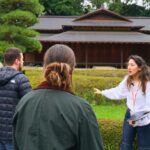
Next comes the main chunk: the Imperial Palace East Gardens stop, with a photo stop and guided walk for about 45 minutes. This is the part that balances history with a break for your eyes. The grounds are peaceful, and the guide points out how the design reflects the grace and authority of both samurai and imperial eras.
One of the big draws here is Ninomaru Garden. You’ll be guided through the garden with attention to details like the ponds and seasonal flowers. Even if you visit during a less showy season, the structure of the garden still reads as intentional—paths, water, and views designed to slow you down. I like that you’re not left wandering alone trying to guess what you’re looking at.
Practical tip: go with a slower camera pace than you think you need. The best photos often come when you pause for a few seconds to take in what the guide is describing—especially when you’re matching viewpoints to features like stone edges, gate lines, or garden sightlines.
Edo Castle stone ruins, gates, and moats you can picture
After the garden intro, the tour turns more sharply toward the Edo Castle story. The tour highlights stone ruins from the castle era, plus original gates and moats from the samurai period. That matters because it’s easy to visit Tokyo and treat history like decoration. Here, you’re seeing remnants that suggest how the old fortress functioned.
One of the most memorable moments is when the guide brings you to the foundation area associated with the castle keep. You’ll stand on or near the foundation remains and be asked to imagine life around the power center—shoguns, feudal lords, and the constant logic of defense and access. You might not have a full “reconstructed castle” view, but you do get a mental picture of scale and placement.
If you’re someone who likes history that explains real-world design, you’ll probably find this portion satisfying. Gates and moats aren’t just aesthetic. They were tools for movement, protection, and control. Seeing stone remnants alongside those ideas makes the place feel less like a museum and more like a blueprint.
Sakurada-mon Gate: one stop, a lot of meaning
The tour finishes with a stop at Sakurada-mon Gate, including a photo stop, guided commentary, and sightseeing for about 20 minutes. This portion works as a capstone because it ties together the physical elements—gates, edges, transitions—into one story you can remember.
Why this matters: gates aren’t random. They’re where people enter, negotiate access, and experience the shift from outside to inside. In a place linked to feudal power, the gate is a stage. With the guide’s framing, you’re likely to notice the spatial logic more clearly than you would if you just pass through on your own.
The time here is also a good reality check. In less than two hours, you’ve covered palace grounds, garden beauty, castle remnants, and a major gateway. It’s a lot for one tour, but the pacing keeps it from feeling exhausting.






Guides make it: Tony, Jim, and Bell-style clarity
The quality of this kind of tour rises or falls with the guide. Here, the guidance you can expect appears to be strong and human—real explanations, good pacing, and willingness to answer questions.
Tony is specifically mentioned for speaking clearly and loudly for deaf guests, while staying friendly and happy to answer questions. Jim is described as relaxed and funny, and he connects historical context to the present day in a way that lands. Bell gets praised for being engaging, knowledgeable in a practical way, and considerate about making sure everyone in the group feels included.
Even if you don’t know the guide in advance, you can use this as a predictor: choose this tour if you want explanations that feel clear and conversational, not a recital of dates. You’ll get more from the stonework and garden layout when someone helps you read them like a story.
Price and value: $22 for entry plus guided interpretation
At about $22 per person for roughly 90 minutes, this is positioned as a solid value for central Tokyo. The key reason is that admission to the Imperial Palace East Garden is included, so you’re not paying separately just to enter. On top of that, you’re paying for a guided route that gives meaning to what you’d otherwise see as walls, gates, and landscaping.
Is it “cheap” for Tokyo? It’s not a freebie, but it doesn’t try to sell you a long multi-attraction day. You’re paying for targeted stops—palace area viewing, East Gardens time, Edo-related ruins/gate context, and Sakurada-mon commentary—within a short window.
If you have limited time and you want the best shot at understanding what you’re looking at, the price feels fair. If you’re the kind of independent wanderer who loves reading signage slowly and doesn’t care about historical framing, you might question the added cost.
How to make the most of it on the ground
This is a walking tour with photo stops, so your success depends on your own rhythm. You’ll enjoy it more if you’re willing to slow down for pauses rather than treating everything like a checklist.
A few practical moves:
- Wear comfortable shoes. You’ll be on foot for about 1.5–2 hours.
- Bring patience for photo stops. Some moments are brief by design, especially the palace photo viewpoints.
- Ask questions if you get them. The guide is described as happy to answer questions, which can turn a “see it” tour into a “understand it” tour.
- If the garden season is at its peak when you go, you’ll likely spot more seasonal flowers. If it isn’t, focus on pond views and structure.
Also, consider pairing this tour with other nearby palace-area sights before or after, so you don’t feel like you’re cramming everything into the same hour.
Who this tour fits best (and who might want something else)
This is a strong fit if you want:
- History with visible places: Edo Castle stone ruins and samurai-era features, not just lectures.
- A manageable time commitment: about 90 minutes total.
- English live guiding with space for questions.
- Garden time plus power-story context.
You might consider a different option if you want a longer, deeper palace interior experience. This tour’s focus is the East Gardens and key exterior/ruin/gate points. It’s designed to be quick and meaningful rather than exhaustive.
If you’re traveling with mixed interests—someone who loves photos and someone who loves history—this format is a good peace treaty. The garden offers calm beauty, and the stonework offers substance.
Should you book the Imperial Palace East Gardens + Edo Castle tour?
I’d book this tour if you want a focused, guided route that makes Tokyo’s imperial and shogunate past feel readable. The combination of Ninomaru Garden time, Edo Castle stone ruins and moats/gates context, and a guided Sakurada-mon stop is exactly the kind of “small itinerary, big payoff” experience that works well in a city full of must-sees.
You might skip it only if you strongly prefer unguided exploring and signage reading, or if you’re hoping for a much longer, more in-depth palace journey than a 90-minute walk provides.
If you’re deciding today, my advice is simple: if you like understanding what you’re looking at while you’re looking at it, this one is worth your time and price.
FAQ
How long is the Tokyo Imperial Palace, Edo Castle and Historical Tour?
The tour runs for about 90 minutes, roughly 1.5 to 2 hours.
Where do we meet for the tour?
You meet in front of the Starbucks Coffee near Imperial Palace East Garden (the Starbucks at or near Kokyo Gaien Wadakura Fountain Park). Exact details are provided after booking.
Is the tour guided in English?
Yes. The tour includes a live English-speaking guide.
Is admission to the Imperial Palace East Gardens included?
Yes. Admission to the Imperial Palace East Garden is included.
What major areas do we visit during the tour?
You’ll have stops for the Tokyo Imperial Palace (photo and guided tour), the Imperial Palace East Gardens (including Ninomaru Garden time), and Sakurada-mon Gate (photo and sightseeing).
Do you see Edo Castle remnants on this tour?
Yes. The tour focuses on the stone ruins of historic Edo Castle, along with original gates and moats from the samurai era.
Is the tour wheelchair accessible?
Yes, the tour is listed as wheelchair accessible.
Can I cancel and get a full refund?
Yes. You can cancel up to 24 hours in advance for a full refund.
Is there a pay-later option?
Yes. You can reserve now and pay later, so you can book without paying immediately.