REVIEW · TOKYO
MT FUJI with Private Tour
Book on Viator →Operated by HAROON TAHIR · Bookable on Viator
Fuji day trips can feel like a mission. This one makes it simpler: a private Tokyo tour with pickup/drop-off and a tidy 10-hour route to Mt. Fuji’s highlights. You start at 8:00 am, ride in an air-conditioned vehicle, and come back to your starting point—so you’re not stuck figuring out trains between views.
What I like most is the small-group feel. Your driver, Hamza, has been noted for being helpful and flexible, including working with changes in your plan when possible. That matters when roads, timing, or photo stops don’t go exactly as planned.
The main drawback to plan around is cost creep. Several key places don’t include admission (Mt. Fuji 5th Station, Arakurayama Sengen Park, Yamanakako Hananomiyako Park, and Narusawa Ice Cave), and lunch isn’t provided—so you’ll likely pay extra on the day.
In This Review
- Key things to know before you go
- Why this private Mt. Fuji tour works better than DIY
- Route overview: a 10-hour day shaped around Mt. Fuji icons
- Fuji 5th Station: where the views start strong
- Oshino Hakkai springs: a calm, almost magical science moment
- Arakurayama Sengen Park: shrines, pagodas, and the postcard deck
- Lake Yamanaka: classic Fuji Five Lakes scenery
- Yamanakako Hananomiyako Park: seasonal flowers near the lake
- Narusawa Ice Cave: geology you can feel
- Optional Oishi Park: lavender scenery with a view
- Optional Gotemba Premium Outlets: shop without losing the Fuji framing
- Price and value: $654 per group can be a deal
- What’s included, what to pack, and how to plan your lunch
- The driver factor: Hamza’s flexibility matters
- Who should book this Mt. Fuji private tour
- Should you book this private Mt. Fuji tour?
- FAQ
- What is the duration of the Mt. Fuji with Private Tour?
- Where does the tour start and end?
- What time does the tour start?
- How many people are in the group?
- Is pickup offered from my accommodation?
- What attractions are included in the itinerary?
- Are admission tickets included?
- Is lunch included?
- What is included in the price?
- FAQ
- Can I cancel for a full refund?
- Are service animals allowed?
- When do I receive confirmation after booking?
- Is the tour ticket mobile-based?
- Is there onboard WiFi?
Key things to know before you go
- Private pricing for up to 4: the tour price is per group (up to 4), which can make the day very good value compared with per-person private rides.
- Max 6 travelers: even though it’s priced as a private group, the experience is capped small, which keeps the schedule calmer.
- Driver flexibility (Hamza): if your plans change, this tour’s approach is practical and hands-on.
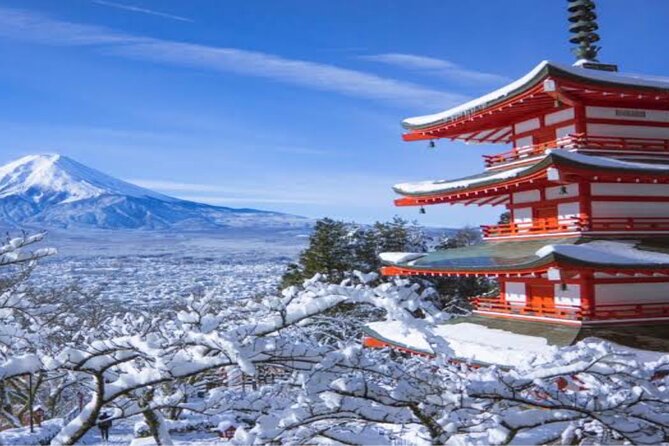
- Fuji views in multiple styles: you get a Mt. Fuji viewpoint at the 5th Station plus classic postcard scenery at Arakurayama Sengen Park.
- Oshino Hakkai springs are included-free time: 1 hour at the springs with admission listed as free.
- Optional add-ons keep control in your hands: Oishi Park and Gotemba Premium Outlets are included as optional stops.
Why this private Mt. Fuji tour works better than DIY
A Mt. Fuji day can become a time trap fast. You want the iconic stops, but you also want to avoid the stress of transfers, line-hunting, and “wait, which bus goes where?” This tour is built as a single day loop from Tokyo with hotel/nearby pickup and drop-off, plus onboard WiFi and bottled water to make the long day feel less heavy.
I also like the way the itinerary mixes big-name sights with quieter rhythm. You get the big view moments (5th Station and the Arakurayama observation deck area) and then shift into slower scenery at places like Oshino Hakkai and the Fuji Five Lakes area.
One more practical note: you’re spending about 10 hours total. That’s enough time to see a lot, but it still stays realistic as a day trip, not a two-day project.
You can also read our reviews of more private tours in Tokyo

Route overview: a 10-hour day shaped around Mt. Fuji icons
The day starts at 8:00 am and ends back at your meeting point in Tokyo. Stops are spaced so you can take in each area without feeling like you’re sprinting from one photo spot to the next.
Here’s how the flow plays out:
- Mt. Fuji 5th Station (1 hour)
- Oshino Hakkai (1 hour)
- Arakurayama Sengen Park (1 hour)
- Lake Yamanaka (1 hour)
- Yamanakako Hananomiyako Park (1 hour)
- Narusawa Ice Cave (50 minutes)
- Optional: Oishi Park (30 minutes)
- Optional: Gotemba Premium Outlets (30 minutes)
The itinerary is set up so you don’t just stare at the mountain. You also see how Fuji shows up in water (springs), in viewpoints (observation decks and parks), and in geology (an ice cave formed by volcanic activity).
Fuji 5th Station: where the views start strong
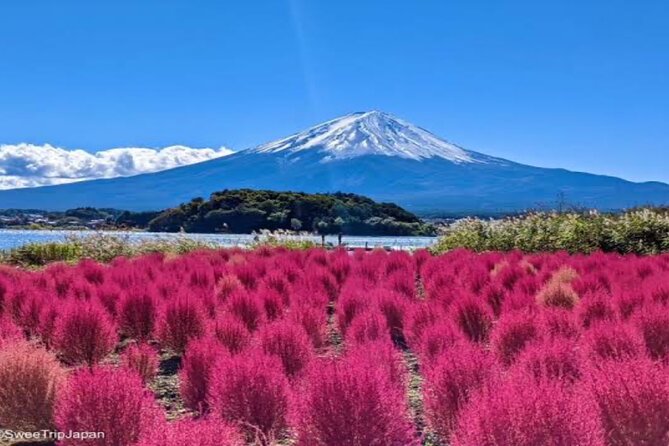
Your first real “wow” stop is Mt. Fuji 5th Station, with about an hour on site. This is one of the most famous vantage points, and the whole pitch here is the panoramic sweep: you’re standing near the mountain with views down across the valleys and peaks.
What to love:
- The timing puts you at the mountain early in the day, which is when you’ll get the most out of your photo time.
- You’re given a full hour, not a 15-minute photo drive-by.
What to watch:
- Admission for Mt. Fuji 5th Station isn’t included.
- If you’re someone who wants extra time to walk around and linger at viewpoints, you may wish you had a bit more than 1 hour.
If you want the classic Fuji moment, start here and treat the time like your main viewing block.
Oshino Hakkai springs: a calm, almost magical science moment
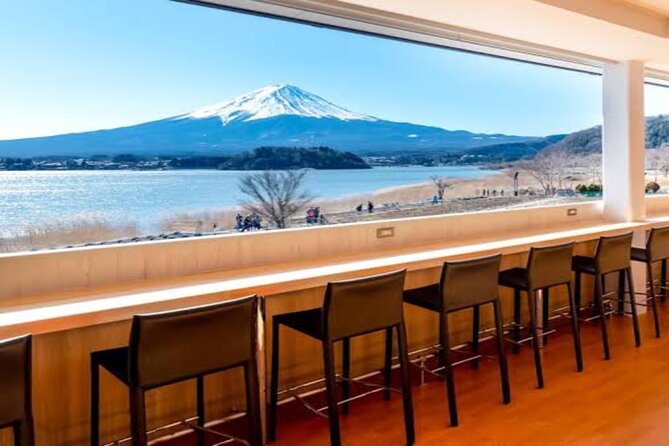
Next up is Oshino Hakkai, a cluster of eight springs formed by snow water that flows through the ground from Mount Fuji. This is one of those stops that feels special because it’s not only about the mountain’s look—it’s about where that water goes and how it forms a whole landscape of springs.
What I like:
- You spend 1 hour here.
- Admission is listed as free, which makes this a good value add to the day.
Practical consideration:
- It’s easy to mentally rush this one, because you’re thinking about the next big view. Don’t. The whole point is to slow down and notice the spring setting and the route between the springs.
If you like the idea of understanding Fuji beyond postcards, Oshino Hakkai is your payoff stop.
Arakurayama Sengen Park: shrines, pagodas, and the postcard deck
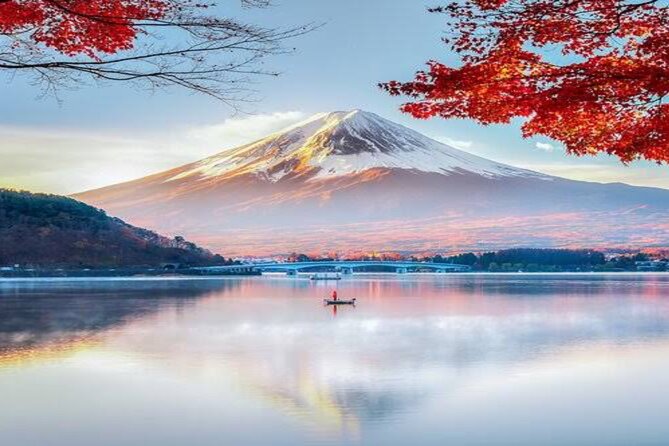
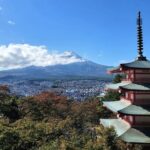
Arakurayama Sengen Park gives you a very Japanese kind of view: shrines and pagodas in a park setting, with the famous Mount Fuji Observation Deck halfway up the mountain. This is the type of scene that shows up on postcards for a reason.
What makes it worth a full hour:
- You’re not just viewing from a single platform. The park setting suggests you’ll move around and take in both the structures and the view.
- It’s timed as its own block, not squeezed between lunch and the next long drive.
The drawback to factor in:
- Admission isn’t included for this stop.
- Also, because it’s a park with viewpoints and structures, you’ll want comfortable shoes and a pace you can maintain.
If your idea of a great Fuji day includes both culture and scenery, this is the stop that ties them together.






Lake Yamanaka: classic Fuji Five Lakes scenery
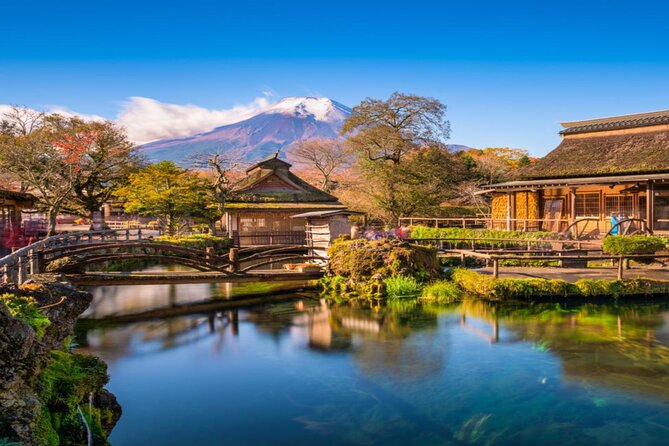
After the park, you head to Lake Yamanaka for about 1 hour. This is part of the Fuji Five Lakes area near Yamanashi Prefecture. The key detail here is scale and elevation: Lake Yamanaka is the largest of the Fuji Five Lakes by surface area and the highest in elevation.
What you’re likely to enjoy:
- This stop shifts you from shrines-and-deck views into open water views and wider sightlines.
- You get a dedicated 1-hour window, which helps you avoid feeling rushed while looking toward the mountain.
A small caution:
- Lake views can be affected by weather and light, so your best move is to treat this as a viewing window rather than a single make-or-break moment.
Yamanakako Hananomiyako Park: seasonal flowers near the lake
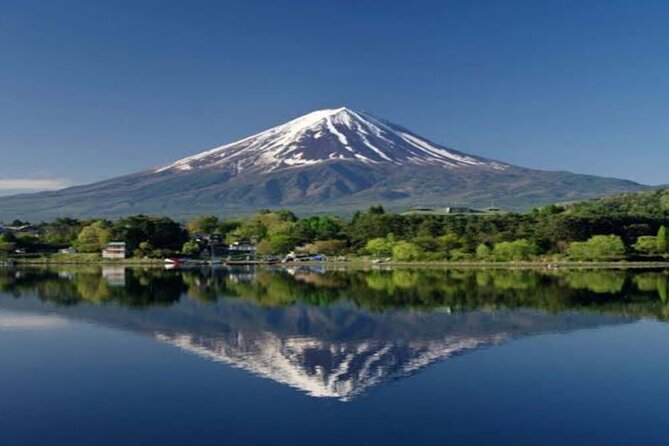
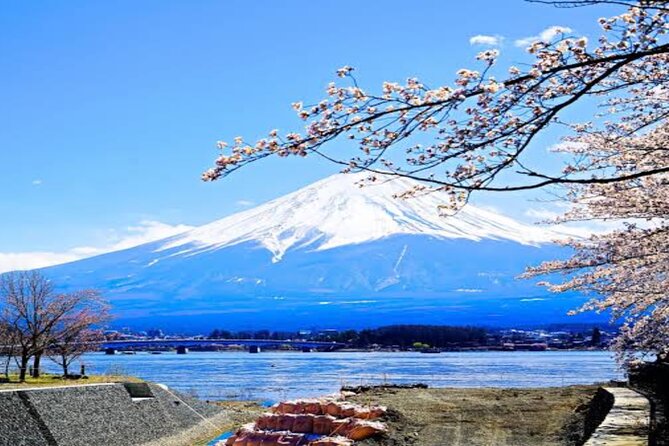
Next is Yamanakako Hananomiyako Park (Flower Park), again with a 1-hour visit. This park focuses on seasonal flowers along the bank of Lake Yamanakako nearest Mt. Fuji, aiming for bright color and a vivid lakeside feel.
Why this works in the itinerary:
- It gives you a different mood than the springs and decks.
- It’s another way to see Mt. Fuji positioned within a lived-in scenery setting, not only at viewpoints.
What to keep in mind:
- Admission isn’t included for this stop.
- Because it’s a flower-focused park, timing within the day matters less than the season itself, so go in expecting nature-focused scenery rather than a guaranteed peak bloom moment.
Narusawa Ice Cave: geology you can feel
Your next stop is Narusawa Ice Cave, a 50-minute visit. The story here is volcanic: after Mt. Nagao erupted in 864, lava hollowed out a cave, and the ice cave developed as part of that volcanic aftermath. The temperature drops as you walk through, so this stop has a built-in sensory change.
What I like about it:
- It’s not another viewpoint. You get a physical, temperature-based experience.
- The time is short enough to keep the day moving, but long enough to take it in.
The consideration:
- Admission isn’t included.
- Wear layers you can manage comfortably inside and outside, because the cave is described as cooling down steadily as you go.
If you want one part of the day that feels more like an activity than sightseeing, this is it.
Optional Oishi Park: lavender scenery with a view
There are optional add-ons after Narusawa Ice Cave:
- Oishi Park (30 minutes, free admission) is known for panoramic views over Lake Kawaguchi and Mt. Fuji, with lavender fields mentioned as part of the scene.
This is a good choice if you want more of the “wide scenery” feeling. It’s also a strong option if you want a lighter stop after the cave, since it’s shorter and more relaxed by nature of being a park viewpoint.
Optional Gotemba Premium Outlets: shop without losing the Fuji framing
Another optional stop is Gotemba Premium Outlets (30 minutes, free admission). It’s described as one of Japan’s largest outlet centers, located on a large site with Mt. Fuji in view. It’s also connected in the description to the World Cultural Heritage site area around Mt. Fuji.
This optional block is useful if:
- You want something practical for the end of the day (snacks, gifts, or last-minute shopping).
- You’d rather spend the final time browsing than packing in one more viewpoint.
If shopping isn’t your thing, you can skip it and keep the day focused on scenery and nature.
Price and value: $654 per group can be a deal
The tour is priced at $654.01 per group for up to 4 people. That price structure is the big value lever. If you’re traveling as a couple, you may find it pricier than shared bus tours. If you’re traveling as a small group of four, the math gets much nicer.
What you’re paying for:
- Private, scheduled transportation from Tokyo with pickup and drop-off.
- A small group cap (max 6 travelers overall) and onboard WiFi plus bottled water.
- An itinerary built around multiple Mt. Fuji-related regions in one day.
What can change your final cost:
- Several admissions are not included, including Mt. Fuji 5th Station and places like Arakurayama Sengen Park, Yamanakako Hananomiyako Park, and Narusawa Ice Cave.
- Lunch isn’t provided.
- If you choose any extra experiences not included in your package, like the cruise on Lake Kawaguchiko or the Kuchi Kuchi Ropeway, you’ll need separate tickets. (Those specific add-ons are mentioned as not included.)
My practical advice: look at this as a transportation-and-guidance package with sightseeing stops, and budget a little extra for admissions and food.
What’s included, what to pack, and how to plan your lunch
Included in the tour:
- Bottled water
- Air-conditioned vehicle
- WiFi on board
- Mobile ticket
Not included:
- Lunch
- Tickets for Mt. Fuji 5th Station admission
- Tickets for Arakurayama Sengen Park, Yamanakako Hananomiyako Park, and Narusawa Ice Cave (admission listed as not included for each)
- Tickets for the cruise on Lake Kawaguchiko and Kuchikuch Ropeway (also listed as not included)
So I’d plan your day like this:
- Have breakfast before pickup.
- Treat lunch as something you handle on your own during the day rather than expecting it to be included.
- Bring a little extra cash or a card ready for admissions at the non-included stops.
Also, confirmation is received at booking time, which helps you feel set rather than guessing.
The driver factor: Hamza’s flexibility matters
One reason I’d consider a private Fuji day in particular is how quickly plans can need adjusting. Traffic happens. Weather can change. A viewpoint can take longer or less time than expected.
This tour is operated through HAROON TAHIR, and Hamza has been described as helpful and flexible with changes to plans. That kind of practical attitude can turn a stressful day into a calm one, because you’re not stuck with rigid expectations.
Who should book this Mt. Fuji private tour
This tour fits best if you:
- Want a guided day trip without dealing with train schedules between multiple Fuji-area stops.
- Travel with up to 4 people and want the pricing to feel reasonable.
- Prefer a small-group day where you can actually move through stops without the energy of a huge crowd.
- Appreciate a mix of viewpoints, cultural park settings, nature scenery near the lakes, and one active detour in a cave.
If you’re traveling solo and want maximum privacy, the private feel is still there, but the per-group cost may matter more for your budget.
Should you book this private Mt. Fuji tour?
Yes, if you want a structured Fuji day with pickup, a small group size, and a route that hits the big icons plus a few “how Fuji works” moments like Oshino Hakkai springs and Narusawa Ice Cave. The big win is value: $654 per group up to 4 means friends or family can split the cost and end up paying less than many private car days.
I’d skip or rethink if:
- You want every single admission included and don’t want to plan extra costs.
- You’re sensitive about lunch logistics, since lunch isn’t part of the package.
- You’d rather do a slower multi-day trip, where you can spend more time per lake or per viewpoint.
For most people wanting one strong day of Mt. Fuji without the hassle, this is a solid pick.
FAQ
What is the duration of the Mt. Fuji with Private Tour?
It runs for about 10 hours.
Where does the tour start and end?
It starts in Tokyo, Japan, and ends back at the meeting point.
What time does the tour start?
The start time is 8:00 am.
How many people are in the group?
The experience has a maximum of 6 travelers. Pricing is per group for up to 4.
Is pickup offered from my accommodation?
Yes, pickup is offered.
What attractions are included in the itinerary?
The tour includes Mt. Fuji 5th Station, Oshino Hakkai, Arakurayama Sengen Park, Lake Yamanaka, Yamanakako Hananomiyako Park, and Narusawa Ice Cave. Oishi Park and Gotemba Premium Outlets are optional.
Are admission tickets included?
No for several key stops. Mt. Fuji 5th Station and other listed stops (including Arakurayama Sengen Park, Yamanakako Hananomiyako Park, and Narusawa Ice Cave) show admission tickets as not included. Oshino Hakkai and Lake Yamanaka are listed as free for admission.
Is lunch included?
No, lunch is not provided.
What is included in the price?
Bottled water, an air-conditioned vehicle, and WiFi on board are included. The tour also uses a mobile ticket.
FAQ
Can I cancel for a full refund?
Yes. You can cancel up to 24 hours in advance of the experience for a full refund.
Are service animals allowed?
Yes, service animals are allowed.
When do I receive confirmation after booking?
Confirmation is received at the time of booking.
Is the tour ticket mobile-based?
Yes, a mobile ticket is provided.
Is there onboard WiFi?
Yes, WiFi is included on board.