REVIEW · TOKYO
Tokyo Asakusa Sensoji Temple Night Walking Tour
Book on Viator →Operated by Japan Wonder Travel · Bookable on Viator
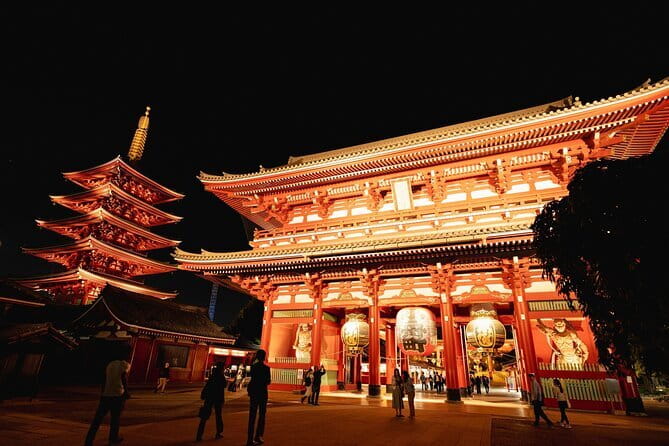
Sensoji looks different after dark. This Tokyo Asakusa night walking tour keeps the pace easy while you see the lantern glow, the Thunder Gate, and the surrounding streets when they’re calmer. I like that the plan is straightforward and focused, with free admission at every featured stop.
Two things I really like about this tour are the short, well-timed stops and the way it helps you picture your evening in Asakusa. You’ll get the big sights first, then practical ideas for snacks, souvenirs, and where to grab a drink right after. The guide also sets you up for what to expect at Sensoji, including the timing around the temple buildings.
One consideration: the Sensoji main hall closes at 6pm, so depending on when your tour runs, you may only be able to enjoy the grounds and the front area rather than going inside. That doesn’t ruin the experience, but it is something to plan around if you’re hoping for an interior look.
In This Review
- Key things to know before you go
- Asakusa at night: why the Thunder Gate hits different
- Meeting point near public transport (and why that matters)
- Stop 1: Kaminarimon Gate and the statues of Fujin and Raijin
- Stop 2: Nakamise Shopping Street for snacks and souvenirs
- Stop 3: Senso-ji Temple—what you can see, and what closes at 6pm
- Stop 4: Hanayashikidori for old Tokyo street energy
- Stop 5: Hoppy Street for izakaya drinks and the local-food hang
- Value check: what $35 gets you in real terms
- Pace and fitness: an easy walk with common-sense expectations
- Who this tour fits best (and who may want a different plan)
- Final thoughts: should you book the Asakusa night walk?
- FAQ
- How long is the Tokyo Asakusa Sensoji Temple Night Walking Tour?
- What is the price per person?
- How many travelers are in the group?
- Is there a mobile ticket?
- Where do I meet the guide?
- Where does the tour end?
- What stops are included during the walk?
- Is entry included at the temple and shopping areas?
- What time should I know about for entering Senso-ji?
- What is the cancellation policy?
- Is the meeting point near public transportation?
Key things to know before you go
- Small group (max 8): easier questions, less waiting, and you stay together in the streets.
- Night-time atmosphere: Asakusa’s core sights, but at a quieter time of day.
- Photo-first route: Kaminarimon Gate and its red lantern are built into the schedule.
- Practical street recommendations: you’ll pick up ideas for snacks and drinks as you walk.
- Sensoji timing reality: main hall closes at 6pm, so you might not go inside.
- Ends on Hoppy Street: a natural jump-off point for izakayas after the tour.
Asakusa at night: why the Thunder Gate hits different
Asakusa’s Sensoji area is famous, but daytime can feel like a fast-moving photo race. At night, the same landmarks feel more human-scaled. You get the iconic view of the red lantern at Kaminarimon, but with less pressure to move every second.
This tour is also built for orientation. In about 1 hour 30 minutes, you cover the main spine of the area: the gate, the shopping street leading toward the temple, then the streets where people linger after dark. If you’re arriving with a blank slate, I think this kind of night walk is a smart way to learn where things are before you decide where to eat.
You’re not rushed through a checklist either. The pace is light enough that you can stop for a photo, look around, and still feel like you’re part of the neighborhood instead of passing through it like a conveyor belt.
You can also read our reviews of more walking tours in Tokyo


Meeting point near public transport (and why that matters)
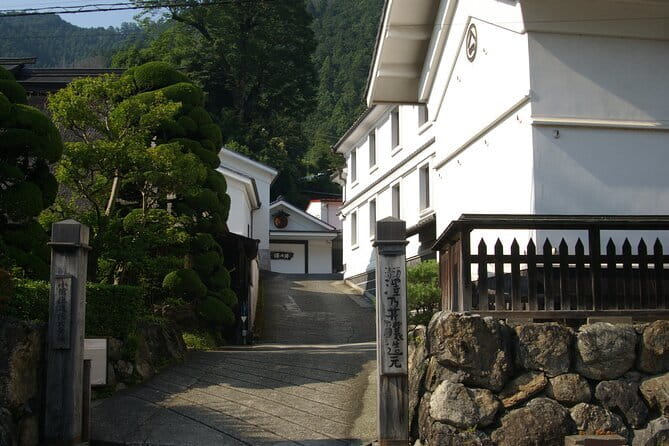
The meeting spot is the Asakusa Culture Tourist Information Center, at 2-chōme-18-9 Kaminarimon, Taito City, Tokyo 111-0034. The tour ends on Hoppy Street at Hoppy St, 2-chōme-8 Asakusa, Taito City, Tokyo 111-0032.
I like meeting locations like this because they reduce stress. You’re not hunting down a tiny side street with no signage. The tour also notes it’s near public transportation, which is a big deal in Tokyo where timing and transfers can make or break your day.
You’ll also use a mobile ticket, which keeps things simple once you’re in Japan. And with a capped group size of up to 8 travelers, you won’t be fighting a crowd just to hear the guide’s explanations.
Stop 1: Kaminarimon Gate and the statues of Fujin and Raijin
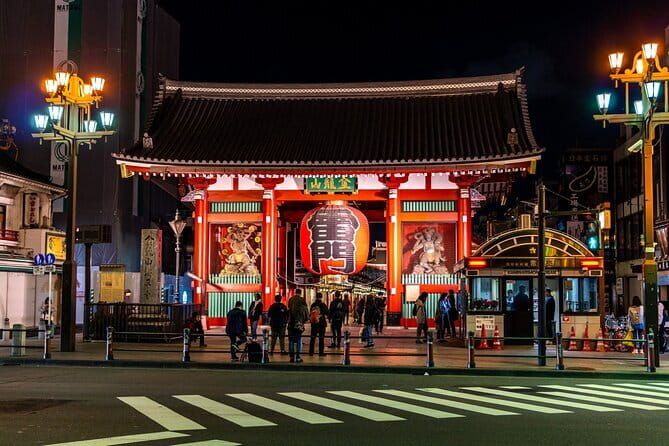
Your walk starts at Kaminarimon Gate, the iconic entrance to Sensoji Temple. This is the place most people recognize instantly: the “Thunder Gate” with statues of Fujin and Raijin on either side.
There’s also the big red lantern hanging in the center, which is exactly the kind of thing that looks better in real life than on a phone screen. Even if you’ve seen it online, being there in person still gives you that quick jolt of, Yep, this is the landmark.
The scheduled time here is about 10 minutes, and it’s long enough to do three useful things: get oriented, take photos without rushing, and understand what you’re looking at before you move deeper into Asakusa. Admission at this stop is free, so you’re not waiting on tickets or lines to enjoy the view.
Stop 2: Nakamise Shopping Street for snacks and souvenirs
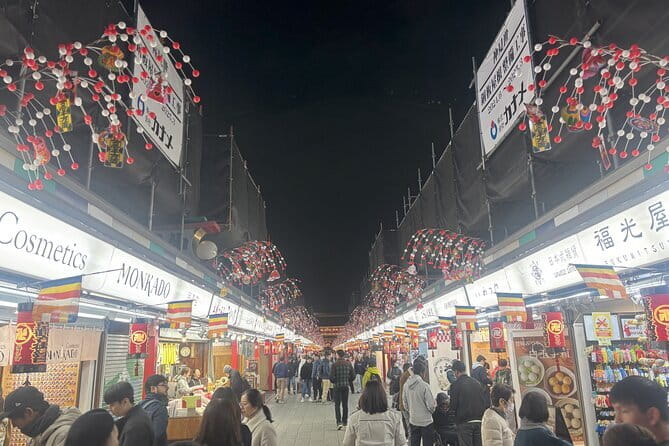
Next comes Nakamise Shopping Street, directly connected to Kaminarimon and leading toward the temple. This street is known for traditional snacks, souvenirs, and crafts.
The value of this stop isn’t just shopping. It’s learning the rhythms of the area. You’ll see what kinds of items dominate—things that make sense as gifts, quick bites, and small keepsakes. And because it’s a short segment (about 10 minutes), you can browse without getting trapped in decision fatigue.
If you’re hungry, this is also where your senses start working. You’ll pick up ideas for what to try later, especially if you want to compare snacks from the temple-side area with what you find on the evening streets after the tour ends.
Admission is free here too, which makes it feel low-pressure: you can look, sample if you want, and keep moving.
Stop 3: Senso-ji Temple—what you can see, and what closes at 6pm
At the main stop, you’ll reach Senso-ji Temple, dedicated to the goddess of mercy Kannon. This is one of Tokyo’s oldest and most famous temples, and the atmosphere around it is part spiritual space, part neighborhood landmark.
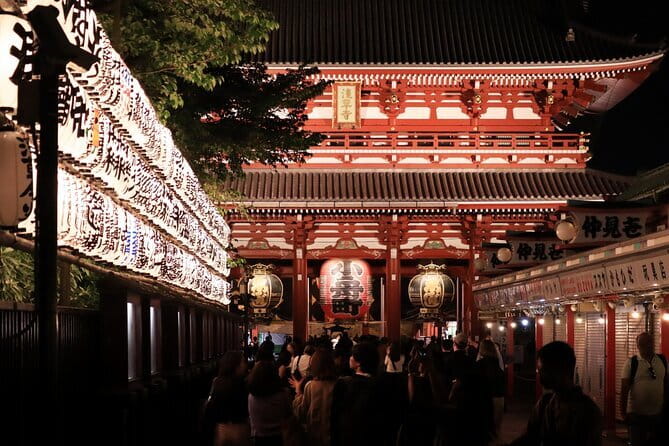
The scheduled time is about 30 minutes, which is helpful. You’ll have enough room to slow down, understand the setting, and take in the temple’s main gate area—especially the photo-famous Kaminarimon Gate view.
Here’s the practical heads-up: the main hall closes at 6pm, so you may not be able to enter the main hall depending on the tour timing. You can still enjoy the temple grounds and the front area after that point, but if your priority is going inside, you’ll want to plan around that closing time.
If you’re the type who likes learning what you’re looking at, this is where a guide earns their keep. Knowing that the temple centers on Kannon helps you interpret the atmosphere instead of treating it like a photo backdrop.
Admission is free at this stop as well, so you’re paying for the guided time and orientation, not for entry.
You can also read our reviews of more evening experiences in Tokyo


Stop 4: Hanayashikidori for old Tokyo street energy
After Senso-ji, the route shifts into a more everyday Asakusa feel with Hanayashikidori. This street is named after Hanayashiki, described as Japan’s oldest amusement park nearby.
That detail matters because it explains the vibe. You’re no longer only in temple-land and souvenir stalls. You’re walking through a small stretch of shops and places to eat and drink that feels nostalgic, like older Tokyo spilling into the present.
You get about 20 minutes here. That’s enough time to look through shops without feeling like you’re on a strict timer. It’s also a good break in the middle of the evening because you’re switching from landmark viewing to casual browsing and snack planning.
Admission is free, and that makes it a nice low-cost add-on: even if you don’t buy anything, you’re still getting a sense of how people actually spend time in Asakusa.
Stop 5: Hoppy Street for izakaya drinks and the local-food hang
The last stop is Hoppy Street, where the star is a local drink called Hoppy. This is a street filled with izakayas—Japanese pubs—so it naturally sets up your next step after the tour ends.
The idea here is simple: you’re learning where the evening energy lives. You’ll also see what kinds of food tend to show up with the drinks. The tour description points to yakitori (grilled chicken skewers) and oden (hot pot) as common options.
You’ll get about 20 minutes in this area. That’s usually long enough to feel the atmosphere and pick a direction for where you want to eat after. Since the tour ends at Hoppy Street, you’re not stuck trying to translate what you saw earlier into an actual plan.
It’s a helpful ending because it connects sightseeing with the next practical question: What now? Here, the answer is already written on the streets.
Value check: what $35 gets you in real terms

At $35 per person for roughly 1 hour 30 minutes, this tour is priced like a guided experience, not like a museum ticket. Since admission is free at each of the featured stops, you’re paying mainly for three things:
- Guided flow and timing across a compact area
- Context (what Kaminarimon is, what Senso-ji is dedicated to, and what to expect around closing time)
- Street-level recommendations for where to eat and drink, so your evening doesn’t stall out after the photos
I also like that the group is capped at 8 travelers. In a popular area like Asakusa, that small size can make the difference between enjoying the walk and feeling like you’re just part of a mass shuffle.
One more practical angle: the tour is often booked about 25 days in advance. That suggests the timing and route are popular with people who want a low-stress Asakusa evening. If your travel dates are fixed, planning ahead helps you lock in a slot without last-minute scrambling.
Pace and fitness: an easy walk with common-sense expectations
The tour asks for a moderate physical fitness level. That usually means you’re walking enough to feel it, but not doing anything extreme. The route is designed around short stops and a compact area, so you should feel comfortable as long as you can handle typical city walking.
Also, it’s a night walk. Tokyo streets can be busy even when they feel calmer than daytime, so wear shoes you trust. Bring a light layer if the evening is cool, and plan to keep your phone handy for photos of the lantern and gate.
Who this tour fits best (and who may want a different plan)
This tour is a great match if you:
- Want a quick way to get oriented in Asakusa without a lot of planning
- Like temple landmarks but prefer a guided route that explains what you’re seeing
- Enjoy street browsing and want practical ideas for snacks and drinks afterward
- Travel in a small group or solo and want company without big-tour chaos
You might consider a different plan if:
- You’re specifically trying to get inside the Senso-ji main hall and you know you’ll be arriving after 6pm. The tour schedule includes the temple stop, but the closure affects access.
- You hate walking at night or want long, unstructured time at a single location. This is short-stop touring, not slow wandering all evening.
Final thoughts: should you book the Asakusa night walk?
If you’re visiting Asakusa for the first time and you want a calm, guided way to see the big sights plus the food streets, I’d say book it. The best part is how it ties landmarks to the very practical question of where to go next. You leave with a mental map, snack and drink ideas, and a natural ending on Hoppy Street.
If your top priority is temple interior time after 6pm, then be cautious. You may still get the atmosphere and the main gate views, but the main hall closing means your expectations should adjust.
Overall, this is strong value: free access to the featured sights, a small group, and a route that makes Asakusa feel easy to navigate.
FAQ
How long is the Tokyo Asakusa Sensoji Temple Night Walking Tour?
The tour lasts about 1 hour 30 minutes.
What is the price per person?
The price is $35.00 per person.
How many travelers are in the group?
The tour has a maximum of 8 travelers.
Is there a mobile ticket?
Yes, the tour uses a mobile ticket.
Where do I meet the guide?
You meet at Asakusa Culture Tourist Information Center, 2-chōme-18-9 Kaminarimon, Taito City, Tokyo 111-0034.
Where does the tour end?
The tour ends at Hoppy Street, Hoppy St, 2-chōme-8 Asakusa, Taito City, Tokyo 111-0032.
What stops are included during the walk?
The tour includes Kaminarimon Gate, Nakamise Shopping Street, Senso-ji Temple, Hanayashikidori, and Hoppy Street.
Is entry included at the temple and shopping areas?
Admission is listed as free for the featured stops.
What time should I know about for entering Senso-ji?
The main hall closes at 6pm, so you may not be able to enter depending on timing.
What is the cancellation policy?
You can cancel for a full refund up to 24 hours in advance of the experience’s start time.
Is the meeting point near public transportation?
The meeting point is described as near public transportation.