REVIEW · TOKYO
Samurai Experience Mugai Ryu Iaido in Tokyo
Book on Viator →Operated by Beauty of Japan · Bookable on Viator
Iaido in Tokyo feels oddly personal. In Kuramae, you spend about an hour learning Mugai-ryū sword basics with Master Takeda Hougyoku and a small crew. You’ll handle an imitation blade, swap into traditional hakama, and get hands-on practice plus a kata viewing at the end.
Two things I really like: first, the small group size means you actually get correction, not just a quick demo and a goodbye bow. Second, the setup is practical and safety-minded, using mock katanas while you learn how to draw, hold, and sheath correctly. That matters if you’re worried about doing something “wrong” in front of a master.
One consideration: it’s only about 1 hour, so you’ll leave with solid fundamentals and a feel for the forms, not full mastery. Also, you’ll meet at a specific address in Kuramae—there’s no hotel or attraction pick-up.
In This Review
- Quick reasons this one-hour iaido session works
- Mugai-ryū Iaido in Tokyo: more than a sword demo
- Inside the 60 minutes: what you’ll do, in order
- Safety and your brain: mock katanas make it doable
- Tameshigiri practice: the cutting part (and what it teaches)
- Watching kata with Master Takeda Hougyoku
- What’s included: hakama rental, sword rental, and English guidance
- Price and value: what $151.92 buys you in practice
- Where Kuramae fits in your Tokyo day
- Who should book this Mugai-ryū session
- FAQ
- FAQ
- How long is the Samurai Experience Mugai Ryu Iaido lesson?
- Where does the experience start and end?
- What language is instruction provided in?
- Is there a group size limit?
- Do you use real katanas?
- What is tameshigiri in this lesson?
- Do I get to wear traditional clothing?
- Is a sword provided?
- Is pick-up or drop-off included?
- What if I need to cancel?
- Should you book this iaido experience in Tokyo?
Quick reasons this one-hour iaido session works
- Master-led instruction with Master Takeda Hougyoku (International Iaido Organization Hougyoku-kai)
- Small group up to 8, so coaching stays personal
- You practice real iaido steps: draw, sheath, grip, basic patterns, kata flow
- Tameshigiri practice where cutting is part of the curriculum
- Traditional dress included, with rental hakama for the class feel
- Photos are doable, with lots of moments to capture the experience
Mugai-ryū Iaido in Tokyo: more than a sword demo
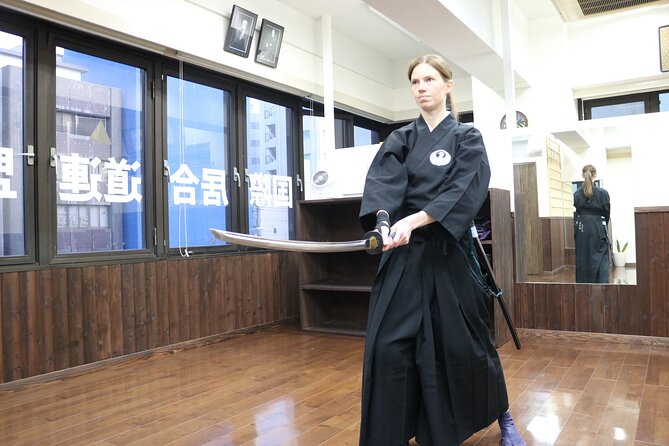
If you’ve seen Japan from the outside—temples, gardens, shiny trains—this is the opposite angle. Iaido is built around precision, timing, and calm movement. The Mugai-ryū approach is described as practical, with kata patterns designed to be usable rather than theatrical.
What makes this class especially appealing is the teacher. Master Takeda Hougyoku is presented as the head of the International Iaido Organization Hougyoku-kai, and the instructor team positions him as a qualified keeper of the Mugairyu line—linked to the idea of a 340-year spirit carried forward. You’re not just learning “how to swing a sword.” You’re learning a disciplined system: what the movement means, what the order is, and how safety and control come first.
And yes, you’ll get that very Japanese “do this in sequence” structure: explanation, then step-by-step practice, then a kata viewing at the end so you can see what the whole thing looks like when it’s done fluently.
You can also read our reviews of more tours and experiences in Tokyo.



Inside the 60 minutes: what you’ll do, in order
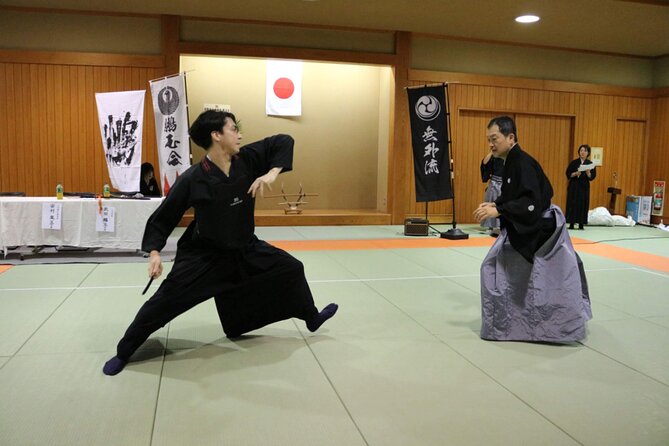
This lesson is tightly paced. Plan to treat it like a workout that also happens to be cultural education.
Here’s the flow you can expect:
First, you change clothes. You’re in rental hakama during the experience, which instantly changes your posture and how you move. Even before the sword work, that’s part of the lesson.
Next comes the explanation phase. You’ll listen to what iaido is, and you’ll also get an overview of how the experience works: how to handle the sword safely (with imitation blades), how to draw and sheath, and how to hold it correctly.
After that, you move into hands-on basics: learning basic patterns and the movement flow. The goal isn’t to impress someone with speed. It’s to build the muscle memory for order, spacing, and controlled technique.
Then the lesson adds the cutting practice: tameshigiri. You’ll get the chance to try it as part of the 60-minute session.
Finally, you watch a demonstration and end with a chance to see real kata before you. That last piece is key. You’ll understand why the early steps matter once you see the complete forms.
Safety and your brain: mock katanas make it doable
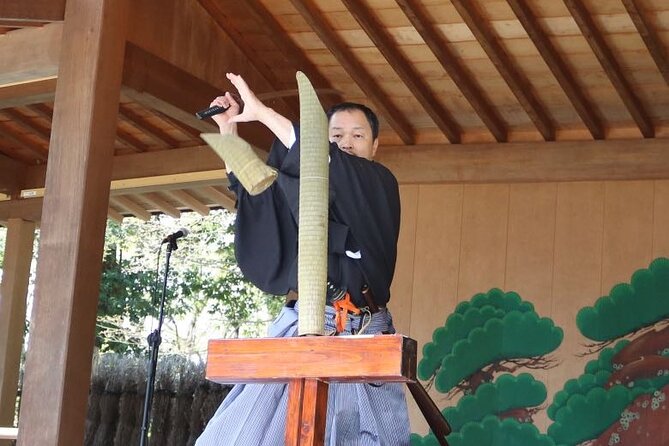
Let’s talk about the big worry people have with sword experiences. You don’t want to feel like you’re one mistake away from chaos.
Here, the class uses imitation swords (mock katanas), so you can focus on technique and control without the same level of risk you’d associate with live blades. That changes the vibe in a good way: you’re more likely to ask questions, try again if you miss a cue, and settle into the tempo.
You’ll still be handling a weapon-shaped tool, of course. But the teaching sequence supports that. They walk you through how to draw and sheath safely before you practice patterns, which helps your brain switch from tourist mode to “follow the form” mode.
One more real-world benefit: it’s easier to relax. When you’re not constantly bracing for danger, you can actually pay attention to what your hands and feet are doing.
Tameshigiri practice: the cutting part (and what it teaches)
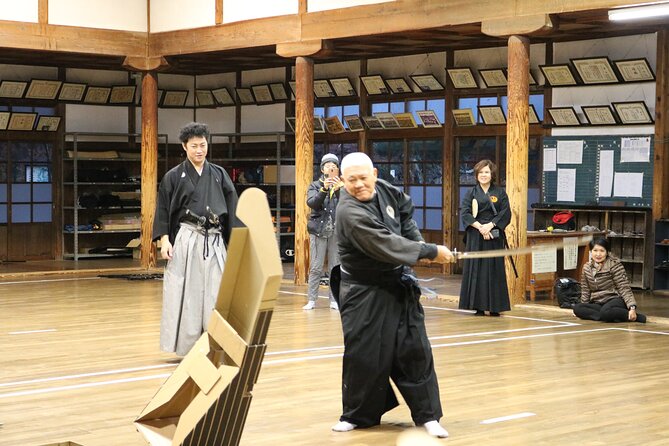
“Tameshigiri” is cutting practice in the iaido world. In this experience, it’s included as a hands-on step, meaning you don’t just hear the term—you get a chance to try it as part of the lesson’s structure.
Why is this valuable, especially for people who aren’t martial artists? Because cutting practice forces clarity. You can’t rely on vibes or guesswork. You need timing and alignment. You also need to coordinate the movement so the draw and the strike stay connected.
Also, cutting practice often helps students understand the difference between “holding a sword” and “performing a technique.” With the earlier basics—drawing, sheathing, gripping, and patterns—you build mechanics. Tameshigiri tests whether those mechanics translate into an outcome.
If you’re deciding whether this is worth it: this is one of the points that makes it feel like an actual lesson instead of a photo-friendly performance. You’re participating in the curriculum.
Watching kata with Master Takeda Hougyoku
The lesson includes a demonstration of Mugai-ryū iaido kata—kata being predetermined patterns of attack and technique. You’ll watch a demonstration by the Mugai-ryū master, and then you’ll get a chance to see real kata at the end.
From a student perspective, end-of-session kata viewing is the best timing. Early on, you’re learning rules. By the end, you can compare what you practiced with what “finished” technique looks like.
And because the master is specifically identified as Master Takeda Hougyoku, this isn’t a generic offstage demo. It’s framed as instruction coming from the head of an iaido organization (Hougyoku-kai), with him presented as entrusted to carry on the tradition of Mugairyu.
If you enjoy learning cultures through movement, this part can be the most memorable. It’s one thing to understand sword terms. It’s another to see how the pieces fit together: the calm start, the snap of timing, and the controlled finish.






What’s included: hakama rental, sword rental, and English guidance
This experience includes:
- Rental hakama (samurai clothing)
- An English-speaking instructor
- Japanese sword rental
That inclusion matters for value. You’re not paying extra to track down clothing or a place to borrow equipment. You also don’t need prior experience, because the class covers the flow from the safe handling basics onward.
You should know what’s not included: there’s no pick-up or drop-off from hotels or tourist attractions. You’ll start and end at the meeting point back in the same location.
The meeting point is:
4-chōme-20-10 Kuramae, Taito City, Tokyo 111-0051, Japan
If you’re tight on schedule, it helps to build your day around returning there. Also, it’s noted as near public transportation, so you can plan to arrive by subway or train and keep the travel time predictable.
Price and value: what $151.92 buys you in practice
At $151.92 per person for roughly 1 hour, it isn’t “cheap entertainment.” But it’s also not a random souvenir stop. You’re paying for three things that are hard to replicate cheaply:
1) Instruction quality and attention: the group is capped at 8 travelers/participants, which gives you a better shot at correction and feedback than a larger crowd format.
2) Hands-on curriculum: you don’t only watch. You change clothes, learn the flow, practice basic patterns, and try tameshigiri.
3) Included gear: rental hakama and the sword rental are part of the price, so the cost reflects an actual activity, not just a guide walking you past a venue.
Booking timing also hints at demand: it’s commonly booked around 9 days in advance on average. If you want a specific time slot, don’t wait until the last minute.
In plain terms: this is a good value if you want a real class feel—movement, correction, and a kata viewing—within a tight Tokyo schedule.
Where Kuramae fits in your Tokyo day
Kuramae is not positioned here as a “tourist cluster” stop. Instead, you’re showing up for a focused lesson in a specific neighborhood.
Because there’s no pick-up, your best strategy is simple: plan to arrive using public transit, arrive a little early, and avoid stacking a lot of other timed activities right before or after.
Also, the session ends back at the meeting point. That’s helpful if you like to keep your plans flexible afterward, since you’re not getting transported to a different area at the end.
If you’re a frequent Tokyo visitor, this is a nice change of pace from typical sightseeing. If it’s your first time in Tokyo, it’s a solid “different side of culture” experience: a controlled, respectful practice that doesn’t rely on you knowing any Japanese in advance.
Who should book this Mugai-ryū session
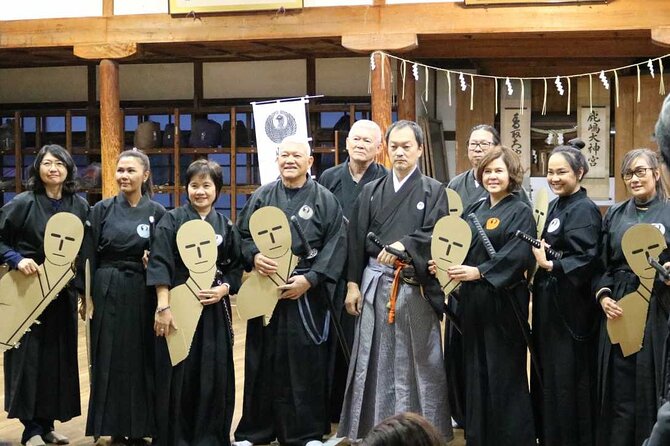
Book it if you:
- Want a hands-on Japanese cultural experience tied to martial tradition
- Like clear structure: safety briefing, then step-by-step practice, then kata viewing
- Prefer small-group teaching (max 8) over big-group theater
- Are curious about iaido beyond the postcard version
- Want photos but also want to participate, not just watch
Skip it only if:
- You’re hoping to learn everything deeply in one hour
- You need round-trip hotel/attraction transport (it’s not offered)
- You’re uncomfortable changing into rental traditional clothing (you will change outfits during the class)
FAQ
FAQ
How long is the Samurai Experience Mugai Ryu Iaido lesson?
It’s approximately 1 hour.
Where does the experience start and end?
It starts at 4-chōme-20-10 Kuramae, Taito City, Tokyo 111-0051, Japan and ends back at the meeting point.
What language is instruction provided in?
The instructor is English-speaking.
Is there a group size limit?
Yes. The experience has a maximum of 8 travelers.
Do you use real katanas?
No. The experience uses imitation swords, and the program is described as using mock katanas for safety.
What is tameshigiri in this lesson?
Tameshigiri is when samurai practice by using the sword to cut something.
Do I get to wear traditional clothing?
Yes. Rental hakama (samurai clothing) is included.
Is a sword provided?
Yes. Japanese sword rental is included.
Is pick-up or drop-off included?
No. Pick-up and drop-off at tourist attractions or hotels are not included.
What if I need to cancel?
You can cancel for a full refund if you cancel at least 24 hours before the experience starts. Free cancellation is available up to 24 hours in advance.
Should you book this iaido experience in Tokyo?
If you want an authentic, hands-on cultural activity with clear structure, this is a strong yes. The mix of fundamentals, tameshigiri practice, and kata viewing by Master Takeda Hougyoku makes it feel like you’re stepping into the discipline—not just watching from the sidelines. The small group size is the quiet hero here.
If budget is tight or you hate any form of outfit change, you might feel the cost and time constraints more. But if you can make it to Kuramae and you’re excited by technique and calm, controlled movement, this one-hour class is a smart use of time in Tokyo.
If you tell me your travel dates and whether you’re traveling with anyone who’s nervous about swords, I can help you decide when to book and how to pair this with the rest of your day.