REVIEW · TOKYO
【50 mins】 City lights HelicopterTour: Tokyo and Yokohama plan
Book on Viator →Bookable on Viator
Tokyo looks different from the sky. This night helicopter ride strings together Tokyo’s biggest icons and Yokohama’s harbor lights, with over 50 minutes in the air to watch the city change as darkness settles.
I like the safety-focused, professional feel I get from the way the operation runs and the emphasis on an experienced pilot and friendly hosts. I also really like the visual payoff: Tokyo Skytree, Rainbow Bridge, Tokyo Tower, Shinjuku, and Yokohama Harbour all show up from above, so you’re not just seeing one skyline—you’re seeing a whole lineup.
One consideration: it’s expensive for a small group, and your flight depends on good weather. If you’re flexible on date and budget, it becomes a rare kind of Tokyo night-view upgrade.
In This Review
- Key Things to Know Before You Fly
- What Makes This Tokyo and Yokohama Night Helicopter Flight Worth It
- Funabashi Heliport: Where You Start and Why It Matters
- The 50-Minute Night Flight: How the Time Adds Up
- Tokyo Skytree From Above: One Landmark You Can Actually Track
- Rainbow Bridge at Night: Geometry, Water, and Light Reflections
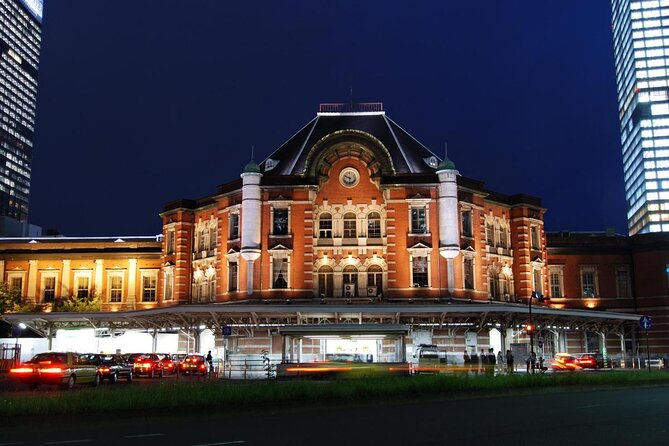
- Tokyo Tower in the Dark: Icon Status, No Effort Required
- Shinjuku After Dark: Dense Lights Without the Ground Chaos
- Yokohama Harbour: A Different Night Mood From the Water’s Edge
- Comfort, Limits, and Who Should Skip This One
- Price and Value: What You’re Really Paying For
- Weather and Day-of Reality (So You’re Not Surprised)
- Should You Book This Tokyo and Yokohama City Lights Helicopter Tour?
- FAQ
- How long is the flight, and how long is the full experience?
- Where is the meeting point for this tour?
- How many people can be in a booking?
- What are the weight limits?
- What happens if the helicopter tour can’t fly due to weather?
- When can I cancel for a full refund?
Key Things to Know Before You Fly
- 50 minutes in the air: the main event, not a quick skim over the city
- Private for up to 3 people: you and your group only, not a mixed crowd
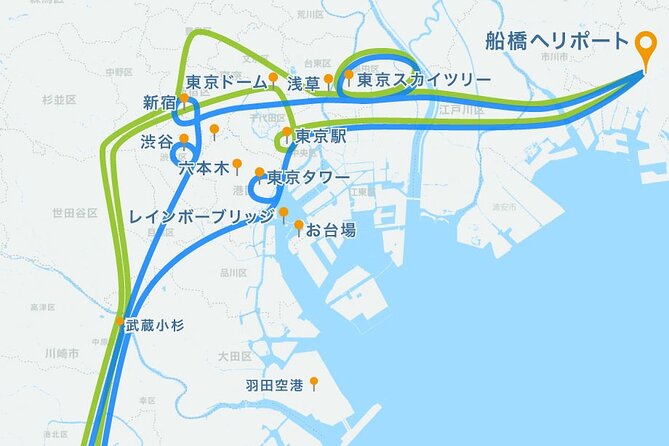
- Route hits Tokyo + Yokohama: Skytree, Rainbow Bridge, Tokyo Tower, Shinjuku, plus Yokohama Harbour
- Funabashi departure: plan to get to Funabashi Heliport before takeoff time
- Weather-dependent: if conditions aren’t right, you’ll switch dates or get a full refund
- Weight limits matter: plan around the 120kg (265 lb) per passenger cap
What Makes This Tokyo and Yokohama Night Helicopter Flight Worth It
This is one of those experiences where the value is not in a long lecture or a lot of stops on foot. The value is time in the air and seeing Tokyo’s “night grid” from a perspective you just can’t get from street level.
You’ll be flying after dark with views that are all about geometry: straight lines of bridges, stacked blocks of towers, and waves of light along major corridors. From the ground, Tokyo at night can feel chaotic. From above, it starts to look organized—almost like a living circuit board.
The route is built for big-ticket visuals. You get Tokyo Skytree (a tall, easy-to-track landmark), Rainbow Bridge (made for night lighting and reflections), Tokyo Tower (instantly recognizable), and Shinjuku (a dense cluster of illuminated buildings). Then you cross into Yokohama Harbour, where the feel shifts from inland towers to shoreline and port-area lighting.
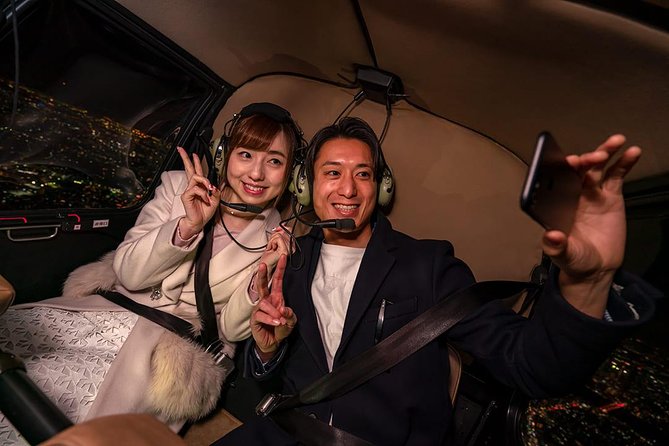
And because it’s a private group for up to three people, the trip has a “special occasion” energy even when it’s just two friends celebrating a birthday. One person even shared that the flight worked perfectly for a surprise proposal at the perfect moment—exactly the kind of memory this format tends to create.
You can also read our reviews of more city tours in Tokyo

Funabashi Heliport: Where You Start and Why It Matters
Your departure and return both happen at Funabashi Heliport. That matters more than it sounds. Flying out of a set heliport means your whole plan is simpler: you’re not bouncing between multiple terminals or dealing with a long transfer chain on the back end.
The meeting point is:
Funabashi Heliport, 1-chōme-44-2230 Kanasugi, Funabashi, Chiba 273-0853, Japan.
A couple of practical notes from the tour details:
- It’s near public transportation, which is a relief if you don’t want to rely entirely on a taxi.
- You’ll need your mobile ticket, so make sure it’s accessible offline in case cell service gets spotty.
- This is a private tour/activity, meaning only your group participates.
That private setup is a real part of the “feel.” You aren’t waiting around with strangers from ten different schedules, which can keep the mood calm and focused right before takeoff.
The 50-Minute Night Flight: How the Time Adds Up
The overall experience runs about 1 hour 30 minutes, with about 50 minutes of flight time. Those numbers are important, because helicopter rides can vary a lot in how much “air time” you actually get.
Here’s what that ratio tends to mean for you:
- The booking gives you a generous chunk of flight, not a token loop.
- You’ll have enough time to spot landmarks and still notice how the lighting changes as you move across neighborhoods.
If you have any control over timing, I’d aim for a sunset-to-early-night window when possible. One shared tip highlighted the magic of seeing Tokyo right after the sun sets—when the city lighting snaps on and you get that quick transition from softer sky to full-on neon brightness.
This flight is designed for night. That means you shouldn’t expect a “daytime city tour with scenery explanations.” What you’re buying is the view, measured in minutes.
Tokyo Skytree From Above: One Landmark You Can Actually Track
Tokyo Skytree is the kind of target that makes a night flight satisfying. Even in darkness, it’s tall and bright enough to keep your eyes anchored.
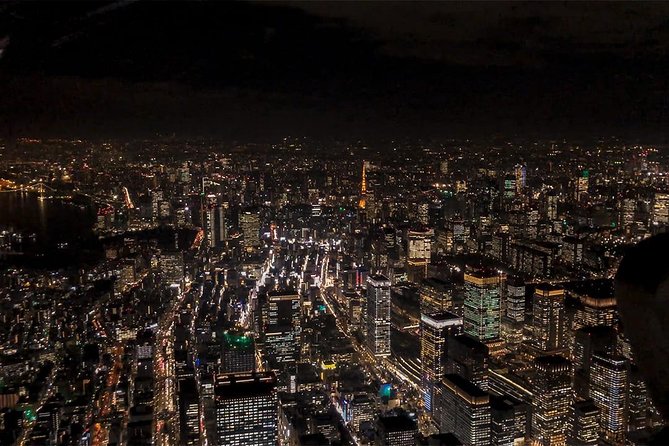
From the air, Skytree isn’t just a point on a skyline. It becomes a vertical reference line. As the helicopter moves, you can compare the tower’s position against surrounding light patterns, and that helps you “read” the city visually instead of just admiring it.
What I like about this stop (even if you don’t consider yourself a skyline person):
- It gives you a clear sense of direction.
- It’s visually dramatic without needing narration.
- It makes photo spotting easier because it’s recognizable fast.
A small consideration: night photos from helicopters can be hit or miss depending on window angle and glare. If your goal is photos, keep your expectations realistic. The bigger win is seeing it directly with your own eyes.
Rainbow Bridge at Night: Geometry, Water, and Light Reflections
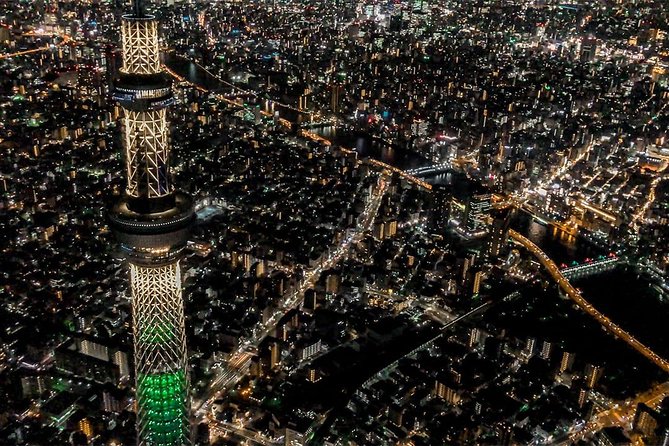
Rainbow Bridge is one of those places that looks good no matter what time it is. At night, it gains a whole extra layer: the lighting has somewhere to “bounce.”
From above, you’ll likely notice:
- The bridge’s structure and length more clearly than you can from a walkway or roadside view
- How the line of light interacts with the dark water below
- The way the bridge connects different city zones, visually “mapping” Tokyo’s movement
If you’re someone who enjoys engineering or just loves clean straight lines in your photos, this is a great moment in the flight. It turns Tokyo into a set of luminous connections rather than scattered attractions.
One practical thought: since this is a night flight, cloud cover matters. If visibility is reduced, the bridge’s outline and reflections may look softer. That’s part of the weather reality with helicopters.





Tokyo Tower in the Dark: Icon Status, No Effort Required
Tokyo Tower is famous, and from the air that fame becomes useful. You don’t have to hunt for it.
Instead, it serves like a bright landmark marker. As you move, Tokyo Tower helps you understand the flight’s broader arc across the city. It also gives you that “main character” moment—one of the biggest, most recognizable silhouettes in Japan—lit up like a beacon.
What’s valuable here is the lack of effort. You don’t need to be standing at the right angle for a perfect ground photo. Up in the air, your viewpoint does the work.
Drawback to keep in mind: if you’re traveling with people who only want one specific attraction, this isn’t a “tower-only” flight. You’re going to get a whole route, so the experience is best when you’re open to multiple iconic sights.
Shinjuku After Dark: Dense Lights Without the Ground Chaos
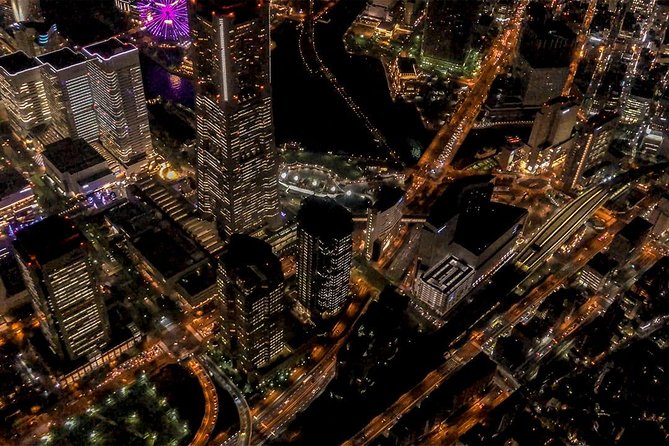
Shinjuku at night is a very specific kind of urban experience. On the ground, it can feel like a busy tangle of signage, crowds, and streets. From above, the same energy becomes patterns.
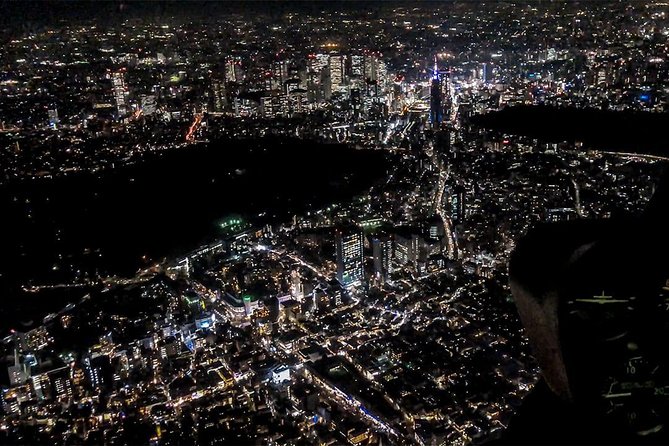
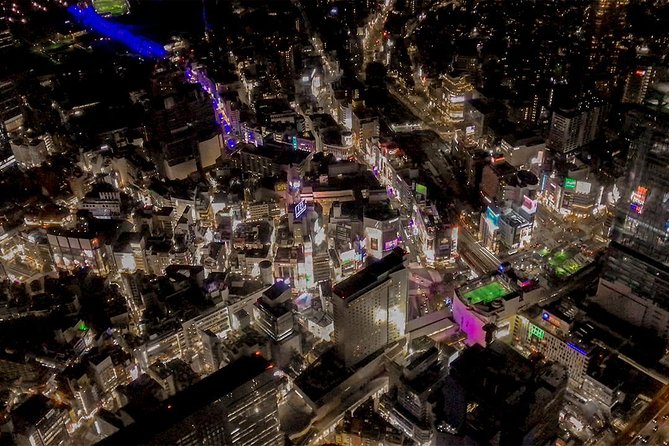
You’ll see illuminated clusters across large blocks of buildings. The air view turns it into something more organized: lines, grids, and stacked light layers. It’s the kind of perspective that helps you appreciate why Shinjuku is famous as a nightlife and city-center hub, without having to negotiate the sidewalks.
One tip based on how night-flight viewing usually works: try to keep your attention moving. Don’t stare too long at one spot. In a 50-minute flight, the best moments are often when you shift your gaze and suddenly realize the city’s shape has changed underneath you.
If you want a single emotional highlight of Shinjuku from above, it’s that sense of scale—how much light sits in such a tight space.
Yokohama Harbour: A Different Night Mood From the Water’s Edge
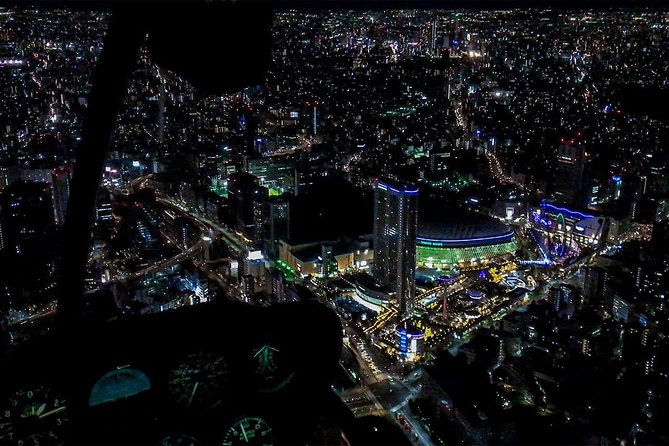
The route doesn’t stop at Tokyo. You also get Yokohama Harbour, and that shift changes the vibe of what you’re seeing.
Tokyo can look like it’s all vertical and crowded. Harbor areas add horizontal lines, shoreline edges, and a sense of the city’s connection to water and shipping routes. Even if you’re not a “port person,” the lighting in these areas often feels different—less like a wall of buildings and more like a coastline of glow.
This is also where the flight can feel like a full night journey rather than a loop over one city. You start to sense you’ve crossed from one type of urban scene into another.
If you’re choosing this flight as a “one big experience” night in the Tokyo region, the Tokyo-plus-Yokohama combination is what justifies the helicopter format. You’re buying variety in the air.
Comfort, Limits, and Who Should Skip This One
A helicopter is a compact ride. You’ll be seated close to your group, and your experience depends on everyone meeting the conditions.
Here are the constraints you should take seriously:
- Weight limit: 120kg (265 lb) per passenger, and 220kg per flight
- Diving rule: if you’ve gone diving in the past 24 hours, you can’t participate
- Flight requires good weather
I also recommend you think about expectations. This is a night city lights flight, so it’s not about learning history on the ground or taking a relaxed walk between viewpoints. It’s about seeing big lights in a short window.
Who this suits best:
- Couples and small friend groups who want a once-in-a-while Tokyo splurge
- People celebrating something and wanting privacy
- View lovers who want aerial landmarks without a long travel day
Who might pass:
- Anyone who gets stressed by weather uncertainty and last-minute date switching
- People over the weight limits
- Anyone who wants a daytime nature-and-culture mix rather than pure city views
Price and Value: What You’re Really Paying For
At $2,002.26 per group (up to 3), this isn’t a deal-shopping experience. The key question is: what does that money buy you that you can’t get another way?
It buys you:
- A lot of actual sky time (about 50 minutes flying)
- A view of multiple iconic neighborhoods in one shot (Tokyo Skytree, Rainbow Bridge, Tokyo Tower, Shinjuku, Yokohama Harbour)
- The convenience of a private group setup, returning to the same heliport
To make the value work, I’d think in terms of cost per person and cost per minute of aerial viewing. If you can share the group price with two others, it starts to feel more reasonable. If you’re traveling solo and every option is priced by the group, it will feel steep.
Also, if you’re already spending time in Tokyo for a short trip, this can be a smart use of time. Helicopter rides don’t require you to cover ground all day; you’re getting the “big city lights” payoff in a compact block.
Weather and Day-of Reality (So You’re Not Surprised)
Helicopters live and die by conditions. This tour is explicitly weather-dependent. If the flight can’t be conducted due to inclement weather or other flight operation issues, you’ll be offered a different date or a full refund.
If you’re planning within the next week, keep an eye on the forecast. The tour notes say that if you want to fly within 5 days, you should check the weather because the tour will be canceled due to bad weather.
My practical advice:
- Build some flexibility into your Tokyo plan if you can.
- Treat this as a highlight, but don’t book it as the only night activity with hard plans afterward.
- If you’re the type who hates last-minute uncertainty, choose a date later in your stay when backup options are easier.
Should You Book This Tokyo and Yokohama City Lights Helicopter Tour?
If your goal is a night skyline memory with major landmarks in one flight, I’d say it’s a strong candidate—especially for a small group of up to three. The blend of Tokyo icons plus Yokohama Harbour gives you variety, and the flight length means you’re not just testing the helicopter waters.
I would book if:
- You’re open to a premium price for a short, high-impact experience
- You want the aerial view of Skytree, Rainbow Bridge, Tokyo Tower, Shinjuku, and then Yokohama
- You can be flexible with weather
I’d hesitate if:
- Your schedule is tight with no backup date
- You’re close to the weight limit
- You’re booking very last-minute without checking forecast conditions
The bottom line: this is a “pay for time in the sky” experience. When it flies, it does something Tokyo does best at night—turns lights into a clear, readable map from above.
FAQ
How long is the flight, and how long is the full experience?
The flight time is about 50 minutes, and the full experience is approximately 1 hour 30 minutes.
Where is the meeting point for this tour?
You meet at Funabashi Heliport (1-chōme-44-2230 Kanasugi, Funabashi, Chiba 273-0853, Japan).
How many people can be in a booking?
This is a private tour/activity, with a maximum of 3 people per booking.
What are the weight limits?
The per-passenger weight limit is 120kg (265 lbs). The weight limit per flight is 220kg.
What happens if the helicopter tour can’t fly due to weather?
The experience requires good weather. If it’s canceled due to poor weather, you’ll be offered an alternative date or a full refund.
When can I cancel for a full refund?
You can cancel up to 24 hours in advance for a full refund. If you cancel less than 24 hours before the start time, the amount paid is not refunded.