REVIEW · TOKYO
Go Karting Tokyo Uptown Experience|7 Top Destinations in 120 Mins
Book on Viator →Operated by Kartzilla Go Kart Tours | Top Cultural & Historic Destinations in Tokyo · Bookable on Viator
Tokyo looks different from a go-kart.
I love how fast this ride helps you get your bearings without getting stuck on crowded trains, and I also like that the guide captures photos and videos as you drive. One thing to plan for: you’ll need the right driving documents, and missing originals can mean cancellation with no refund.
This is set up for an intimate feel, capped at 10 people, and it runs like a smooth, guided loop from a fixed meeting point. You suit up in a costume for standout shots, then roll past major landmarks with enough time to actually notice what you’re seeing. If you want a memorable way to stitch together Tokyo’s highlights in about 1 hour 40 minutes, this is a fun, efficient option.
In This Review
- Key points
- Go-Kart Tokyo: A Fast Way to Get Your Bearings
- What You’re Paying For: The Value of Kart + Costume + Insurance
- Costumes, Photo and Video: Landmarks Without the Usual Hassle
- Small Group, One Meeting Point: How the Ride Stays Smooth
- Licenses and Documents: The Paperwork That Can Cancel Your Ride
- Your Tokyo Route: Skytree to Kabukiza in One Guided Loop
- Tokyo Skytree: The Skyline Giant
- Ryogoku and the Sumo Stadium: Tradition in a Modern City
- Tokyo Station in Marunouchi: Architecture You Can Feel
- Imperial Palace: The Emperor’s Residence Within Edo Castle Grounds
- Tokyo Tower: 333 Meters of Postwar Symbol
- Ginza: High-End Shopping and Night Lights
- Kabukiza Theater: Kabuki’s Famous Home
- Timing and Weather: Why the 1 Hour 40 Minutes Works
- Who This Go-Kart Tour Fits Best
- Practical Tips for a Smooth Ride
- Should You Book This Go-Kart Tour?
- FAQ
- What’s the duration of the go-kart tour?
- How much does it cost per person?
- Where is the meeting point?
- Is pickup and drop-off included?
- What do I need to drive the go-kart?
- What’s included with the tour?
- Do I get my photos and video captured during the tour?
- What happens if the weather is bad?
Key points
- Small group (max 10) keeps the ride more personal and easier to manage than big bus crowds
- Costumes included make landmark driving instantly more photo-friendly
- Guide-led photo and video means you don’t spend the whole time fiddling with your camera
- Fuel, insurance, and kart rental included reduces the “surprise add-on” factor
- Seven major sights in one loop helps you see a lot without spending a day hopping neighborhoods
Go-Kart Tokyo: A Fast Way to Get Your Bearings
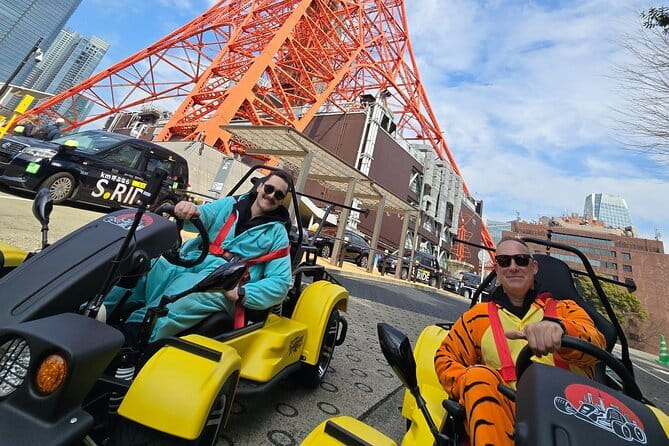
If Tokyo is your first big city stop, it can feel like everything is far apart. This go-kart experience is built to compress that learning curve into one easy outing. In about 1 hour 40 minutes, you get a moving panorama of major landmarks, so the city starts to make sense on the map and in real life.
You’ll trade waiting, transfers, and packed carriage stress for something far more active. It’s also a solid choice if you like “see it now” travel days, not slow days where half your time goes to transit. The route is designed to hit recognizable sights rather than random streets you might miss on your own.
You can also read our reviews of more tours and experiences in Tokyo.



What You’re Paying For: The Value of Kart + Costume + Insurance
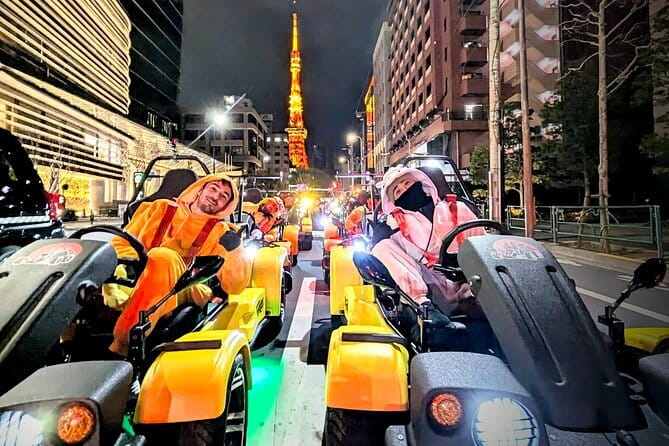
At $117.27 per person, it’s not the cheapest activity in Tokyo. But the price stacks up value because so much is included: kart rental, fuel, insurance, a tour guide, and a costume. You also get photo and video capture and water, which helps if you’re squeezing this into a sightseeing schedule.
This kind of tour can be worth it when you want the complete package: a guide who keeps things flowing, the gear handled for you, and iconic landmarks as the payoff. If you were trying to DIY go-karting, you’d still need to figure out the permits, timing, and safety setup on your own.
Costumes, Photo and Video: Landmarks Without the Usual Hassle
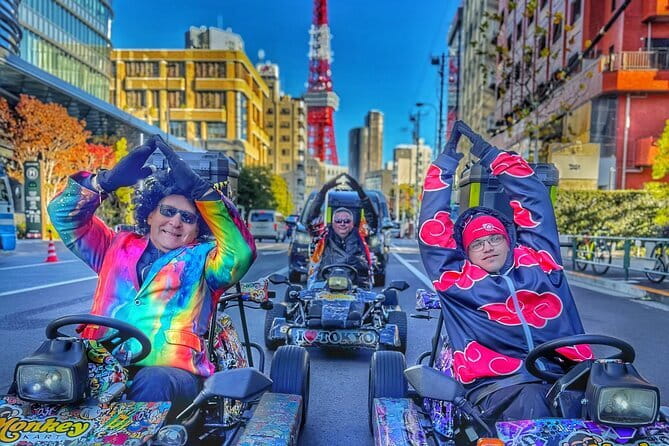
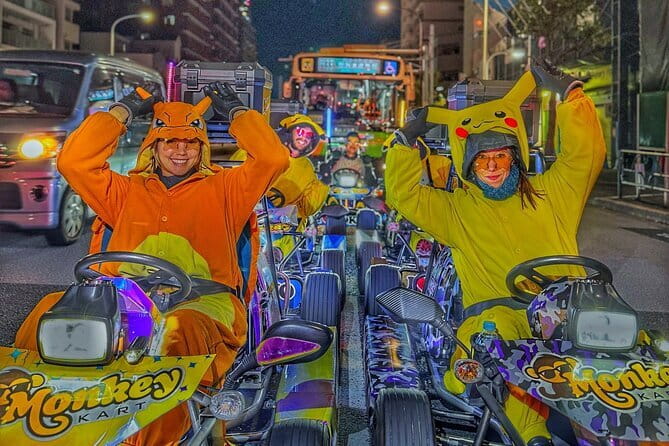
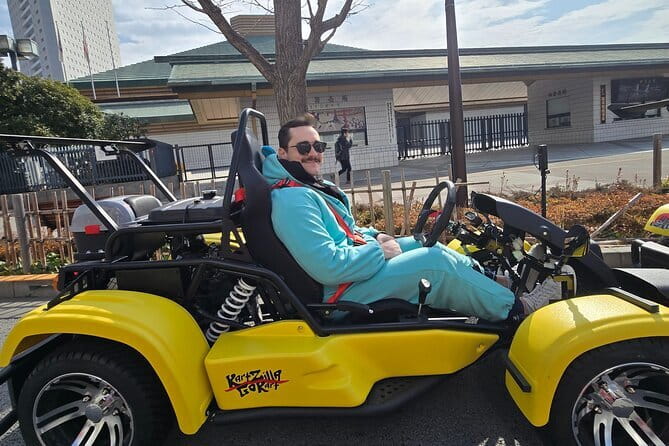
One of the best parts is the costume. It’s not just for fun; it’s also a shortcut to better photos. You’ll be driving past the Tokyo Skytree, Tokyo Tower, and other headline places, so dressing up gives you a different look than the standard “standing on the sidewalk” shot.
The guide also captures photos and videos along the way. That’s a small detail with a big impact: you spend less time stopping, posing, and asking strangers for help. If you’re planning to use an Insta360-style camera, keep in mind a data card for that setup isn’t included (it can be purchased separately).
Small Group, One Meeting Point: How the Ride Stays Smooth
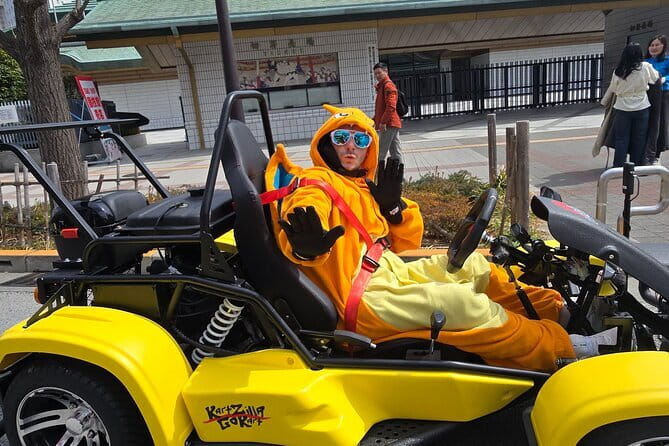
The tour is limited to 10 travelers, which changes the feel right away. Big group tours can turn into a shuffle—lots of waiting, lots of noise, not much personal attention. Here, it’s set up for an intimate experience, so you’re not fighting for the best moments at every stop.
You also start and end at the same location, so you’re not dealing with complicated pickup and drop-off logistics. It’s a near-public-transport meeting point in Katsushika City (Higashiyotsugi, 1-chōme202 小島貸事務所). If you like simple planning, that round-trip setup is reassuring.
Licenses and Documents: The Paperwork That Can Cancel Your Ride
This is the part you cannot treat casually. You’ll need a local driving license and an International Driving Permit (IDP) issued under the 1949 Geneva Convention. For US Forces in Japan (SOFA), a driving license is required as well, not just the IDP piece.
The rules are strict about originals: you must provide the original of your local driving license and your IDP. If you don’t, the tour can be canceled and there is no refund. Bring your passport too, since it’s listed as required.
If you’re from Switzerland, Germany, France, Belgium, Monaco, or Taiwan, you may be able to drive if you have Japanese translation of your driving license available. You’ll need to contact the operator about a month in advance if you fall into that category, so don’t leave it to the last week.




Your Tokyo Route: Skytree to Kabukiza in One Guided Loop
This tour’s route is designed to mix iconic towers, major civic landmarks, and classic Tokyo entertainment districts. You’ll drive past multiple “instant recognition” places, so even if you don’t know the neighborhood names, you’ll know what’s on screen from photos you’ve already seen.
Tokyo Skytree: The Skyline Giant
Your ride begins with Tokyo Skytree, described as the world’s tallest broadcasting and communication tower. It’s located in Sumida City Ward, and it’s the kind of landmark that instantly gives you scale—you can see how wide Tokyo really is.
Driving past it (instead of just viewing it from one spot) helps you understand where the area sits relative to everything else you’ll see next. It’s also a natural first photo moment because the tower dominates the background.
Ryogoku and the Sumo Stadium: Tradition in a Modern City
Next, the route heads through Ryogoku, where the Sumo Stadium takes center stage. This area is all about the link between tradition and modern Tokyo rhythms, and the go-kart format makes that contrast easy to notice as you move through the streets.
If you only know sumo from TV clips, this is a practical way to connect the sport to a specific place in the city. You’ll get that sense of Tokyo having “serious cultural anchors” while still being a fast-moving metropolis.
Tokyo Station in Marunouchi: Architecture You Can Feel
Tokyo Station shows up next, guiding you through the Marunouchi district. This station is tied to early 20th-century architecture, and it’s often treated like a symbol of Tokyo’s modern backbone.
From a kart, you don’t get the slow, contemplative museum pace. Instead, you get a “passing perspective”—enough to clock the size and design without turning the whole day into a single site.
Imperial Palace: The Emperor’s Residence Within Edo Castle Grounds
You’ll also drive past the Imperial Palace, described as the residence of the Japanese Emperor and Empress. The palace grounds trace back to Edo Castle, and the construction date mentioned is 1457, built by Ota Dokan.
This stop is a good reminder that Tokyo isn’t only skyscrapers and shopping streets. It gives your ride a calmer, more ceremonial feeling, even if you’re just passing through at kart speed.
Tokyo Tower: 333 Meters of Postwar Symbol
Then you’ll roll by Tokyo Tower, noted at 333 meters—nearly 3 meters taller than the Eiffel Tower by the numbers given. The tour also frames it as a symbol of resilience, rebirth, and economic recovery after Japan’s hardship.
From the road, you’ll see why it’s so iconic: it’s bold and unmistakable, even against a busy city setting. It’s also a great contrast stop after the palace—two very different “Tokyo symbols” close together.
Ginza: High-End Shopping and Night Lights
Ginza appears next as Tokyo’s well-known upscale shopping and dining area. It’s portrayed as a district with boutiques, art galleries, restaurants, nightclubs, and cafes, which is a lot of cultural and commercial energy for one block of Tokyo.
For a go-kart day, this kind of neighborhood matters. It’s where you get the “this is Tokyo right now” feeling, not just historic landmarks. If you want your route to show Tokyo’s lifestyle side, Ginza is a strong inclusion.
Kabukiza Theater: Kabuki’s Famous Home
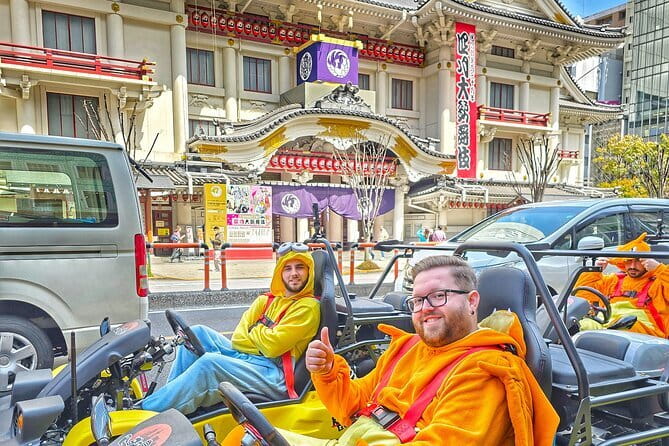
Finally, you’ll pass Kabukiza Theater, described as a cultural and historical landmark for Kabuki—classical Japanese dance-drama with stylized drama, elaborate makeup, and costumes. Even when you’re not stepping inside, passing it gives context for why Kabuki is such a big part of Japan’s performing arts identity.
This is a nice closer because it connects the sightseeing day to Japan’s art forms, not only monuments and towers. After a costume-friendly ride, ending near a place famous for costumes and makeup feels like it clicks.
Timing and Weather: Why the 1 Hour 40 Minutes Works
The experience is about 1 hour 40 minutes. That’s long enough to feel like you did something real, but short enough that you won’t wreck your entire day if you’re also doing museums or shopping.
It also requires good weather. If weather forces a cancellation, you’ll be offered a different date or a full refund. That’s important in Tokyo—scheduling flexibility matters, especially in rainy seasons.
Who This Go-Kart Tour Fits Best
This tour fits best if you want movement and landmark focus in one outing. If your idea of fun includes driving (with the right license), photos, and a guided route through recognizable areas, you’ll likely enjoy it.
It’s also a good fit for people who don’t want to spend their day piecewise solving transit. The small group size and guide support help keep things simple. If you hate the paperwork side of travel, though, this is exactly where you should slow down and get your documents handled first.
Practical Tips for a Smooth Ride
Start by confirming you have the required documents with originals in hand, especially your local license and IDP. The rules are clear that missing originals can lead to cancellation and no refund, so don’t assume a phone photo or expired document counts.
Plan to arrive a bit early at the meeting location in Higashiyotsugi, since it’s listed as near public transportation but still needs a calm start. Dress for comfort because you’ll be in motion for the full ride window, and keep an eye on weather since the operator notes the experience depends on it.
Should You Book This Go-Kart Tour?
I’d book it if you want a short, high-payoff Tokyo day that mixes famous landmarks with actual motion. The value is strong because so many essentials are included—kart rental, costume, fuel, insurance, water, plus guide-captured photos and video. The small group limit of 10 also makes the experience feel more personal than typical big tours.
I’d hesitate if you’re not confident about your driving documentation or you can’t be flexible with weather. For the right person, though, this is one of those activities that turns sightseeing into a story you’ll remember.
FAQ
What’s the duration of the go-kart tour?
The tour lasts about 1 hour 40 minutes.
How much does it cost per person?
The price is listed as $117.27 per person.
Where is the meeting point?
The meeting point is in Tokyo at 124-0014, Katsushika City, Higashiyotsugi, 1-chōme202 小島貸事務所. The tour ends back at the meeting point.
Is pickup and drop-off included?
No. Pickup and drop-off are not included.
What do I need to drive the go-kart?
You need a local driving license and an International Driving Permit (IDP) issued under the 1949 Geneva Convention. US Forces in Japan (SOFA) driving license is required. The tour notes that failure to provide the original documents listed can result in cancellation with no refund.
What’s included with the tour?
Included items are go-kart rental, tour guide, costume, fuel, insurance, photo & video, and water.
Do I get my photos and video captured during the tour?
Yes. Photo & video capture is included with the guide.
What happens if the weather is bad?
The experience requires good weather. If it’s canceled due to poor weather, you’ll be offered a different date or a full refund.