REVIEW · TOKYO
Calligraphy Culture SHODO Experience in Tokyo
Book on Viator →Operated by Tokyo Iriya Shodo Club (Japanese Calligraphy Culture Experience in Tokyo) · Bookable on Viator
Shodo turns your name into art. In Tokyo, this hands-on lesson teaches the basics of Japanese calligraphy, so you’re not just watching—you’re actually making brush strokes that look like the real thing. You’ll practice posture and line-drawing fundamentals, then apply it to writing your own name in Japanese or your favorite word in kanji in a small group setting.
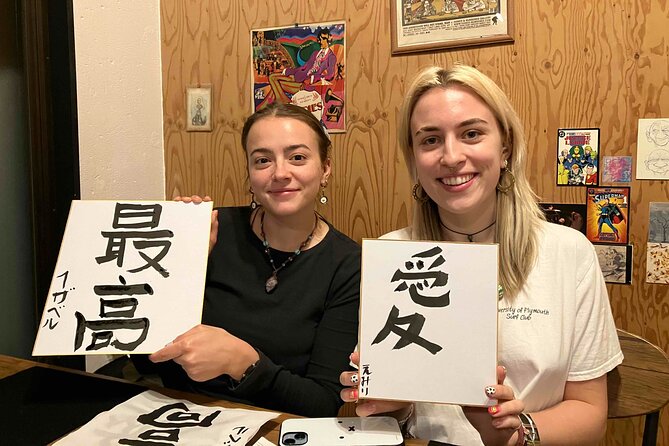
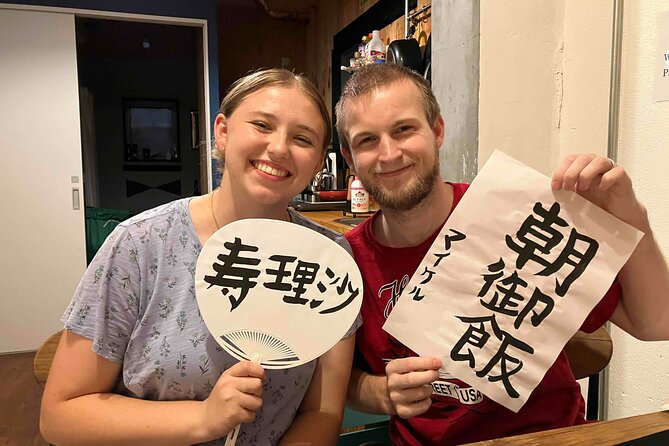
My favorite part is the way the class turns into a personal souvenir, not a mass-produced postcard. You end with a take-home autograph-style board featuring what you wrote, which makes the whole session feel like a real memory instead of a quick activity. One thing to consider: the lesson space can be in a shared hostel-like environment, so you might notice everyday noise or interruptions during class.
In This Review
- Key Highlights Worth Your Time
- What Shodo Teaches You in 90 Minutes
- Price, Timing, and Booking: Is $33 Worth It?
- Where You Meet Near Iriya Station, Asakusa, and Ueno
- Inside the Lesson: From Brush Grip to Your Name in Kanji
- Your Take-Home Autograph Board (and How to Pick a Great Word)
- Teachers and Group Size: Sachie, Zuisen, and the Value of Patience
- A Quick Reality Check on the Classroom Setting
- Who This Experience Suits Best
- Should You Book Tokyo Iriya Shodo Club?
- FAQ
- How long is the calligraphy experience?
- What do I write during the class?
- Are calligraphy supplies included?
- Where do I meet the group?
- How big is the group?
- Can I cancel if my plans change?
Key Highlights Worth Your Time
- Write your name or a kanji word using shodo basics you can actually apply
- Small group limit (up to 5), which usually means more attention than big tours
- Take-home calligraphy board with your final work
- Convenient access near Iriya Station, plus easy connections toward Asakusa and Ueno
- Patient English-speaking teachers, including Sachie and Zuisen in recent lessons
- Japanese calligraphy supplies included, so you can show up and start right away
What Shodo Teaches You in 90 Minutes
Japanese calligraphy, or shodo, is deceptively simple in concept and surprisingly technical in practice. The goal isn’t to make perfect art on the first try. It’s to learn how brush control, pressure, and direction create meaning on the page. In about 1 hour 30 minutes, you get enough structure to leave with both a finished board and a sense of how the strokes are built.
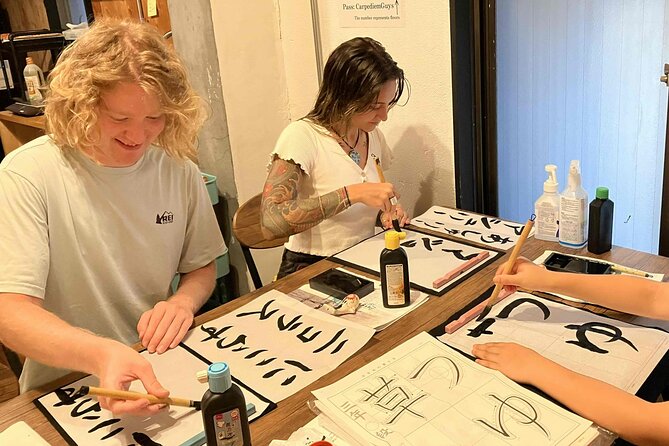
You start with the essentials: how to hold the brush, how to set your posture, and how to draw straight and curved lines in a way that looks intentional. Then you apply those basics to writing a word you care about. That’s the best part of this kind of class. You’re not copying random practice sheets forever. You’re building toward something you’ll want to keep.
And because it’s shodo, it’s also a lesson in mindset. You’ll slow down. You’ll focus. You’ll feel slightly ridiculous trying to write in kana and kanji with a brush, but in a good way—like discovering there’s a physical skill behind what you previously thought was only aesthetics.
You can also read our reviews of more tours and experiences in Tokyo.



Price, Timing, and Booking: Is $33 Worth It?
At $33.03 per person for roughly 90 minutes, this is priced like a short, high-value workshop. The real question is what you get for the money, and here you get three things that matter: instruction, supplies, and a take-home result.
Calligraphy supplies are included, which removes the most annoying friction for first-timers. You’re also not paying for a generic cultural talk. You’re paying to learn brush handling and stroke basics with guidance, then produce a personal final piece. And you leave with your written work on a board, which is a tangible souvenir you don’t have to explain when someone asks what you did in Tokyo.
Booking tends to happen ahead of time, with an average of about 27 days. If your schedule is tight, I’d plan to lock it in a few weeks before your trip. Also, the experience uses a mobile ticket, which is convenient if you’re already managing trains, passes, and last-minute changes.
One practical perk: you can cancel for free up to 24 hours in advance. That gives you breathing room if you’re juggling dinner plans near Asakusa or Ueno.
Where You Meet Near Iriya Station, Asakusa, and Ueno
The meeting point is Tokyo Iriya Shodo Club in Taito City, in the Iriya area. The address is listed at 2-chōme 29-2, 2階 (110-0013 Tokyo). It’s only about a 5-minute walk from Iriya Station, which matters because shodo workshops are easiest when you don’t feel rushed.
I like workshops that place you in a real neighborhood rather than a “tourist-only” pocket. This one is close to the areas most people connect with on their Tokyo itinerary—Asakusa and Ueno. That means you can pair it with a walk, a museum visit, or a snack run without needing a half-day transport plan.
A small practical heads-up: the lesson setup can be inside a hostel-like space. That shows up in the details of how people describe finding the classroom. If you’re the type who hates guessing where to go, just step inside the building and ask at the front or reception area for where the shodo session is.
Inside the Lesson: From Brush Grip to Your Name in Kanji
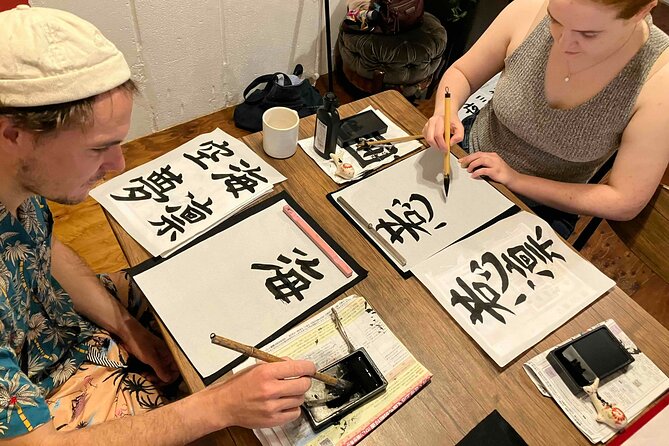
Think of the class like a step-by-step build. You’ll start with fundamentals that make the rest easier.
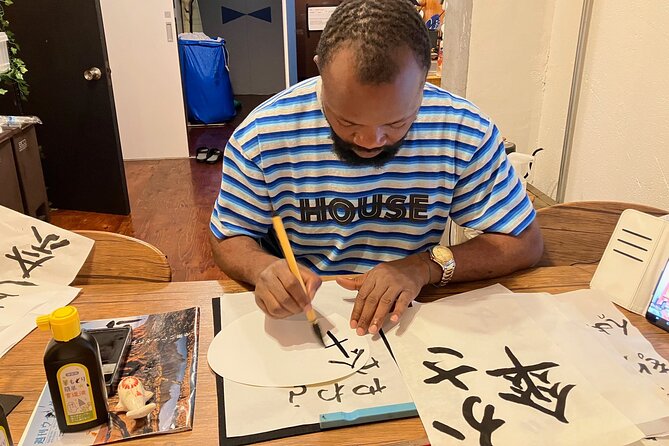
First comes brush handling and posture. You’ll learn how to hold the brush so the tip moves where you intend. Your wrist and fingers will matter, but your overall stance matters more than you’d expect. Japanese calligraphy is physical; the stroke quality depends on you as much as the brush.
Next you’ll practice line-making. You’ll work on the shapes that repeat across kana and kanji: how lines start, how they travel, and how they finish. In plain terms, you’re learning how to control the brush long enough to create consistent thickness and direction.
Then the lesson turns personal. You can write:
- your name in Japanese, and you’ll choose a script appropriate to your request (like katakana or other styles), or
- your favorite word in kanji.
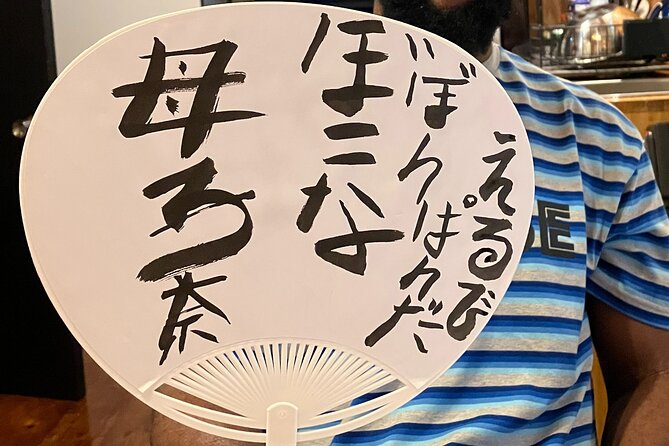
This is where the experience becomes more than a hobby demo. You’re applying technique to something meaningful. And even if you choose a complicated kanji word, that can be part of the fun. One student described trying a word related to knitting in Japanese, which involves challenging characters, and they found it worthwhile because the effort helped them understand the structure behind the writing.
The class is also described as personal and small-group friendly. With a maximum of 5 travelers, you’re more likely to get direct feedback than you would in a larger workshop. If the group ends up very small, it can feel close to a one-on-one lesson.
Your Take-Home Autograph Board (and How to Pick a Great Word)
Most souvenirs in Tokyo are either edible or forgettable. This one works better because it’s authored by you, with real technique behind it. At the end of the workshop, you’ll take home an autograph board with your calligraphy on it.
What should you write? Here’s how I’d make the choice.
If you want an easy win and maximum satisfaction, pick your name in Japanese (often katakana for foreign names). If you want a deeper cultural moment and don’t mind a challenge, choose a kanji word that matters to you—something tied to your trip, hobby, or identity. Just know kanji can be tricky on the first attempt because of stroke order and shape balance.
This is also a souvenir you can actually display. It’s flat, framed by the board format, and it’s specific to your learning. If you’re the kind of traveler who likes taking home something that sparks conversation, a calligraphy board beats most “I was here” items.
And because the class teaches fundamentals first, the board doesn’t feel random. You’re not just copying a template. You’re writing with guidance, then polishing the final result.






Teachers and Group Size: Sachie, Zuisen, and the Value of Patience
A big reason people rate this experience so highly is the teaching style. Recent sessions mention teachers including Sachie and Zuisen, with consistent praise for being friendly, patient, and able to explain the process clearly in English.
In calligraphy, patience isn’t optional. You can’t rush brush technique. If your lines wobble or you lose the flow, a good teacher helps you reset without making it feel like you’re failing. That’s exactly what the reviews emphasize: instruction that’s encouraging, not intimidating.
The small-group size also matters. With a cap of 5 participants, you’re less likely to get brushed past. And in at least some cases, the group can be so small that the lesson becomes highly personal. Even if you’re not guaranteed a solo session, the structure is designed for attention.
One practical bonus: if you’re nerdy about details, you’ll appreciate the way teachers focus on how writing changes between hiragana, katakana, and kanji. Even if you don’t become fluent overnight, you’ll walk away seeing these scripts as systems, not decorative symbols.
A Quick Reality Check on the Classroom Setting
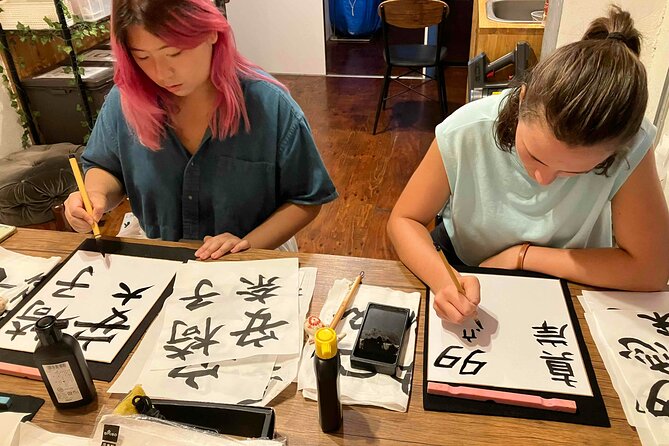
This workshop is described as happening in a cozy classroom that can be part of a hostel-like building. That sounds charming, and it can be. It can also mean ordinary life happens nearby—someone cooking, washing clothes, or moving around while the lesson is going on.
That’s the main drawback to keep in mind. If you’re highly sensitive to noise or you need a quiet environment to concentrate, this is the one element that could affect your experience. The teacher still runs the lesson, but the background activity may interrupt your focus.
If that matters to you, arrive on time so you can settle quickly, and mentally treat the experience like learning in a real neighborhood space. Part of the charm of Tokyo is that it’s lived-in, not stage-managed.
Who This Experience Suits Best
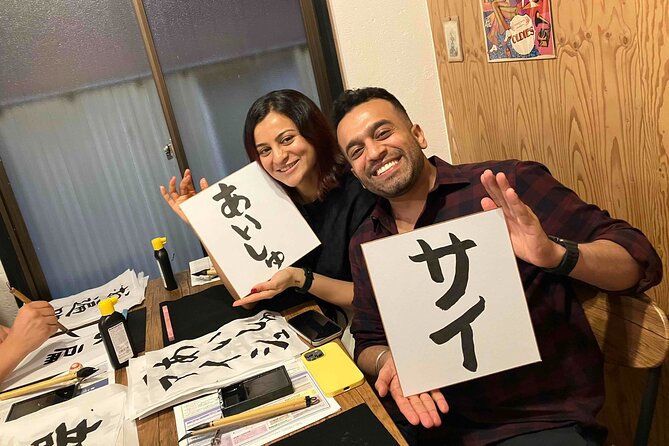
This is a great choice if you want something that feels hands-on and culturally specific. A shodo lesson hits a sweet spot between activity and learning. It’s not just watching art. It’s doing something that uses your body and your attention.
It’s also a good match for:
- first-time visitors who want a genuine Tokyo experience without needing previous Japanese skills
- travelers who like small-group settings and direct guidance
- souvenir collectors who prefer a meaningful item you made, not just bought
- anyone curious about the structure of kana and kanji scripts
If you already know a bit of Japanese, you can use that to choose a word that challenges you appropriately. If you don’t know Japanese at all, the class is still designed for foreign visitors. You’ll be able to write your name and pick a word with support.
Should You Book Tokyo Iriya Shodo Club?
If you’re deciding between generic “culture” activities and something you can actually take home and repeat later, I’d lean toward booking this. The value comes from the combination of instruction, included supplies, a small group, and a finished board you’ll keep.
I’d book especially if:
- you want a memorable, authentic craft experience near Asakusa/Ueno
- you like the idea of writing your own name in a Japanese script
- you care about learning basics like posture and brush control, not just producing a single pretty outcome
I might hesitate if you’re sensitive to background noise in a shared building setting. Otherwise, this is exactly the kind of practical cultural workshop that fits well into a real Tokyo itinerary.
Bottom line: for a little over an hour and a half, you get a guided entry into shodo and a souvenir with your own handwriting on it. That’s a rare combo.
FAQ
How long is the calligraphy experience?
The lesson is about 1 hour 30 minutes.
What do I write during the class?
You can write your name in Japanese or a favorite word in kanji. The class focuses on starting from basics so you can produce your own final work.
Are calligraphy supplies included?
Yes. Calligraphy supplies are included in the experience.
Where do I meet the group?
You meet at Tokyo Iriya Shodo Club in Iriya (Taito City), located at 2-chōme 292 2階. The activity ends back at the meeting point.
How big is the group?
The experience has a maximum of 5 travelers, so it stays small.
Can I cancel if my plans change?
Yes. Free cancellation is available up to 24 hours before the experience start time for a full refund.